Traveling to China with Kids: A Foreign Parent’s Survival Guide
📅 July 2026 | 👨👩👧👦 Foreign families with children | ⏱️ Planning + On-the-ground tips
I’ll be honest with you — the first time I traveled to China with my toddler, I was terrified. Different language, unfamiliar food, and the question that kept me up at night: what if my kid hates it? Spoiler: she loved it. But there are definitely things I wish someone had told me before I went.
This guide is that “someone.” Not a polished tourism brochure — just a fellow parent sharing what actually works when you bring your kids to China. Everything here is based on real experiences, both good and bad.
🎯 Before You Go
Will Chinese People Be OK with My Kids?
This is probably your biggest concern, so let me address it first.
Chinese people absolutely love children. Like, really love them. Strangers will smile at your kid, wave at them, occasionally try to pinch their cheeks (it’s a compliment, I swear). On the high-speed train, an elderly lady offered my daughter candy and spent half an hour playing peek-a-boo with her. In restaurants, waitstaff will bring your kid special treats or let them “help” with small tasks.
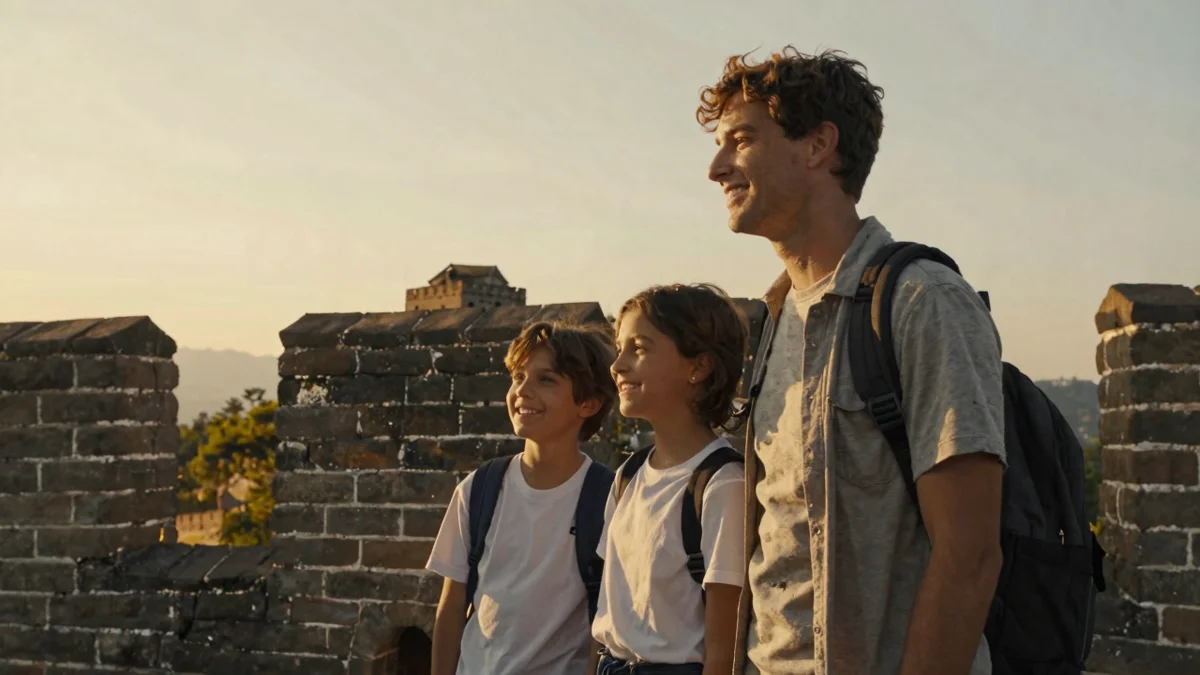
This kid-friendliness is a genuine cultural thing. Chinese families center their lives around children, and that warmth extends to visitors. I’ve found it makes traveling with kids here easier than in many Western countries, counter-intuitively.
| What You Might Worry About | What Actually Happens |
|---|---|
| Strangers touching your kid | Usually just cheek-pinching and smiles — a cultural sign of affection |
| Kids being noisy in public | Chinese parents are generally more tolerant of kid noise than Western ones |
| Getting stared at | You will, but it’s curiosity not hostility; kids break the ice instantly |
| Finding other kids to play with | Chinese kids are very friendly and will try to play even without a common language |
Documents Every Kid Needs
The paperwork is straightforward but don’t skip it:
| Document | Required For | Notes |
|---|---|---|
| Passport | Everyone | Valid for at least 6 months beyond your travel dates |
| Chinese visa (L-visa) | Most nationalities | Kids need their own — can’t be added to a parent’s visa |
| Visa invitation letter | If required | Your hotel can provide this; some travel agencies help too |
| Birth certificate | ⚠️ Bring a copy | Needed for some hotel registrations and the visa process |
| Travel insurance | Strongly recommended | Make sure it covers kids under 18 — most Chinese policies do |
| Vaccination records | Useful to have | Especially if your kid needs medical care |
💡 Visa tip: Kids under 6 often qualify for a simplified visa application. Check with the Chinese embassy in your country — some waive the in-person interview requirement for very young children.
Vaccinations & Health Prep
No mandatory vaccinations for China, but here’s what our pediatrician recommended:
| Vaccine | Recommended? | Notes |
|---|---|---|
| Hepatitis A | ✅ Yes | Common in China, especially with street food |
| Typhoid | ✅ Yes | Especially if eating from smaller vendors |
| Routine shots | ✅ Up to date | MMR, DTaP, polio, etc. |
| Flu shot | ✅ Seasonal | China’s flu season runs October–March |
| Japanese Encephalitis | ⚠️ Consider | Only if visiting rural areas for >1 month |
| Rabies | ⚠️ Consider | Stray dogs exist in some cities |
🏥 First aid kit essentials: Bring children’s ibuprofen/acetaminophen (hard to find specific brands), oral rehydration salts, antihistamines, a thermometer, and any prescription meds your kid needs with a doctor’s note.
🍜 Food: Will My Kids Actually Eat?
This was my biggest worry, and honestly? It went much better than expected. Here’s the real deal.
Chinese Food Kids Actually Love
| Dish | What It Is | Kid-Friendly Factor |
|---|---|---|
| Xiaolongbao (soup dumplings) | Steamed dumplings with meat + soup inside | ⭐⭐⭐⭐⭐ Kids love popping them — let them cool first! |
| Jiaozi (dumplings) | Boiled or pan-fried dumplings | ⭐⭐⭐⭐⭐ Picky-proof; available everywhere |
| Chaoshou (wontons in soup) | Wontons in mild broth | ⭐⭐⭐⭐⭐ Perfect for toddlers |
| Huoguo (hotpot) but mild broth | DIY cooking at the table | ⭐⭐⭐⭐ Fun experience, just skip the spicy broth |
| Baozi (steamed buns) | Filled bread buns | ⭐⭐⭐⭐⭐ Like a sandwich, but steamed |
| Chun juan (spring rolls) | Fried rolls | ⭐⭐⭐⭐ Crunchy and familiar |
| Yangrou chuan (lamb skewers) | Grilled meat on sticks | ⭐⭐⭐⭐ Great for older kids |
| Mian tiao (noodles) | Any noodle dish | ⭐⭐⭐⭐⭐ Universal kid appeal |
| Bai zhout (plain congee) | Rice porridge | ⭐⭐⭐⭐⭐ Easy on stomach, good for breakfast |
| Tangyuan (sweet rice balls) | Glutinous rice balls in sweet soup | ⭐⭐⭐⭐ Dessert-like treat |
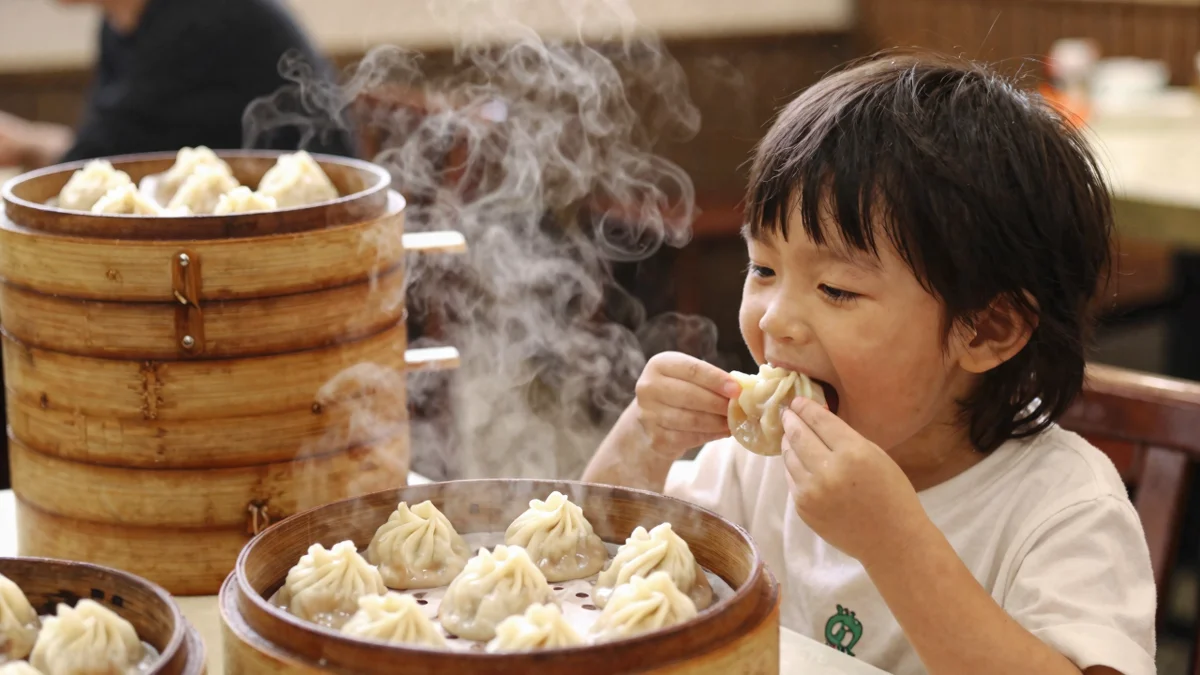
Dealing with Food Allergies
This is genuinely challenging. China’s food allergy awareness is still developing, and cross-contamination is common.
My advice:
- Learn to say “allergy” in Chinese: Guòmǐn (过敏). Write it down on a card.
- Carry translation cards listing your kid’s allergies in Chinese — restaurants will take them to the kitchen.
- Common allergens to watch for:
- 🥜 Peanut oil (花生油 huāshēng yóu) is extremely common in cooking
- 🌾 Soy sauce (酱油 jiàng yóu) is in almost everything
- 🥛 Dairy is less common but appears in western-style cafes
- 🌶️ MSG (味精 wèijīng) is used liberally
- International hotel buffets are the safest bet for allergy concerns
- Bring backup snacks from home for the first few days while you figure things out
Baby Food & Formula
| Item | Availability in China | Notes |
|---|---|---|
| Baby formula | ✅ Widely available | International brands (Aptamil, Nutricia) in bigger cities |
| Baby food jars | ✅ In major cities | Available at Watsons, international supermarkets |
| Familiar Western snacks | ⚠️ Limited | Bring a stash of their favorites |
| Fresh fruit | ✅ Abundant | Apples, bananas, grapes everywhere — easy baby food |
| Yogurt | ✅ Everywhere | Chinese yogurt is sweet — check labels for sugar |
⚠️ Water warning: NEVER give your kids tap water. Not even boiled tap water if you can avoid it. Buy large bottles of purified water at any convenience store (5L bottles are cheap — about ¥10 / ~$1.50).
🏥 Health & Emergencies
Finding a Pediatrician
China’s public hospitals are functional but chaotic. For anything non-emergency, go to an international clinic or VIP section of a public hospital.
| City | Recommended Hospital/Clinic | Notes |
|---|---|---|
| Beijing | Beijing United Family Hospital (和睦家) | English-speaking, Western-trained doctors |
| Shanghai | Parkway Health / Shanghai United Family | Multiple locations, excellent pediatric care |
| Guangzhou | Guangzhou United Family Hospital | Same network, reliable |
| Chengdu | Chengdu United Family Hospital | Smaller but capable |
| Shenzhen | Shenzhen United Family Hospital | Good for south China travel |
⚠️ Emergency rooms in public hospitals will treat anyone but expect long waits and limited English. Always carry your insurance documents and passport.
Common Kid Health Issues in China
| Issue | How Common | What To Do |
|---|---|---|
| Stomach upset | Very common | Oral rehydration salts, BRAT diet (bananas, rice, applesauce, toast) |
| Respiratory issues | Common (smog/air pollution) | N95 masks for kids, air purifier in hotel room |
| Heat exhaustion | Common in summer | Stay hydrated, avoid midday sun, find air-conditioned spaces |
| Insect bites | Moderate, varies by region | Bring kid-safe repellent — DEET-free options preferred |
| Constipation | Common (diet change) | Increase fruit intake, bring pediatric fiber supplements |
Pharmacy Essentials in China
Chinese pharmacies are everywhere (药店 yàodiàn — look for the green cross sign). But getting specific medications can be tricky:
- ✅ Easy to find: Basic first aid supplies, thermometers, children’s ibuprofen (美林 měilín), rehydration salts
- ⚠️ Harder to find: Brand-name Western meds, children’s Benadryl, specific formulas
- ❌ Don’t expect: Homeopathic remedies, chewable tablets (Chinese kids usually swallow pills)
💡 Pro tip: Take photos of your kid’s regular medications before leaving. Show the photo at a pharmacy and the pharmacist can usually find a Chinese equivalent.
🚇 Getting Around with Kids
Metro: The Good and the Bad
China’s metro systems are world-class. But with a stroller? Mixed bag.
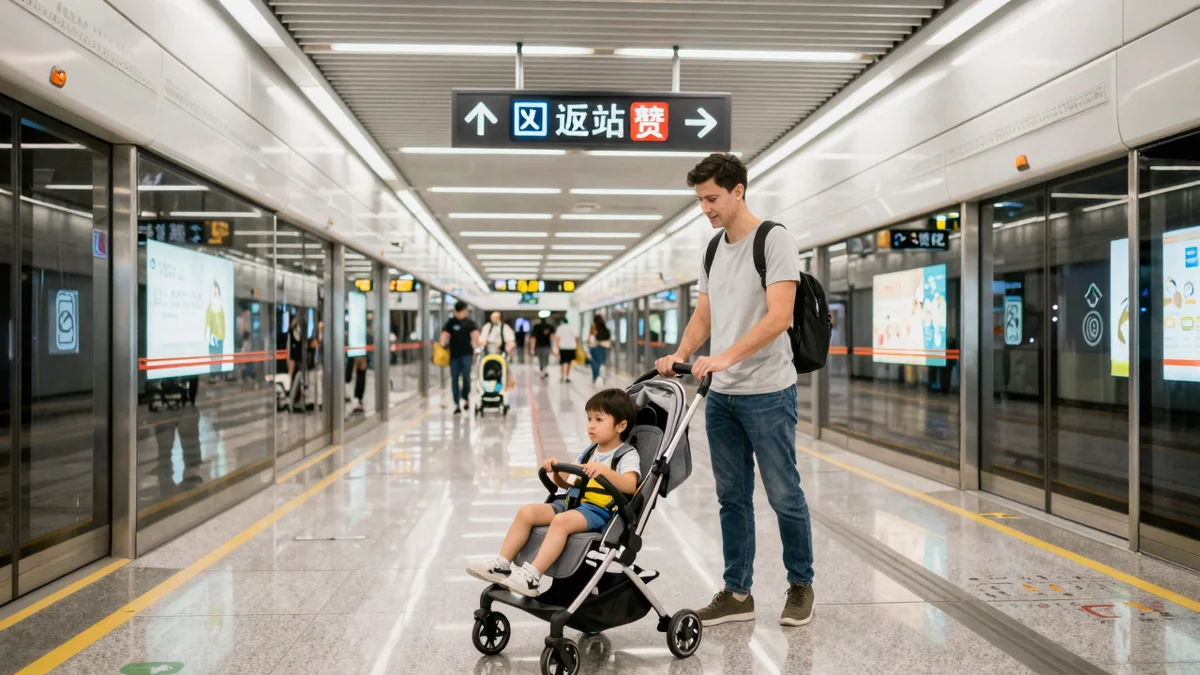
| Pro | Con |
|---|---|
| Clean, air-conditioned stations | Elevators exist but aren’t always obvious — take time to find them |
| Frequent trains (every 2-5 min) | Peak hours are PACKED — avoid 7:30-9:30am and 5:00-7:00pm |
| Cheap (¥3-10 per ride) | Security check means taking the stroller through the X-ray belt |
| English announcements on newer lines | Older lines (Beijing Line 1/2, Shanghai Line 1/2/3) have limited accessibility |
My stroller strategy:
- Use a lightweight, compact stroller, not a bulky travel system
- Bring a baby carrier/sling as backup — essential for stairs
- Enter and exit metro cars through doors at the center of each car (usually wider)
- Download Amap (高德地图) — it shows which station exits have elevators
Taxis and ride-hailing (Didi) are generally easier with kids, just keep in mind:
| Method | Car Seat Available? | Best For |
|---|---|---|
| Didi Premier (豪华车) | ❌ None provided | Note “need car seat” in the comment — some drivers accommodate |
| Regular taxi | ❌ No | Short trips, low speeds |
| High-speed rail | ✅ Bring your own | Long distances — book first-class for more space |
| Domestic flights | ✅ Child seats allowed | Longest distances — book early for bulkhead seats |
High-Speed Rail with Kids
This is genuinely the best way to travel between Chinese cities with children.
| Why It’s Great | Why It’s Tricky |
|---|---|
| Huge legroom — kids can stand and walk | No dedicated changing tables in bathrooms |
| Onboard food carts with snacks | Some stations are enormous (Beijing South, Shanghai Hongqiao — up to 30 min walk to platform) |
| Clean bathrooms | Need to book tickets with passport in advance |
| Fast — Shanghai to Beijing in 4.5 hours | No seat reservation guarantees — buy early for seat selection |
| Stable enough for nap time | Platform tickets not sold — everyone needs a full ticket (kids under 1.2m ride free, no seat) |
💡 High-speed rail pro tip: Book your tickets 2 weeks in advance during Chinese holidays (Golden Week, Spring Festival). The trains sell out. Use Trip.com or 12306 (English version) for booking.
Stroller-Friendly Cities
| City | Stroller Rating | Notes |
|---|---|---|
| Shanghai | ⭐⭐⭐⭐⭐ | Most accessible — wide sidewalks, ramps everywhere |
| Shenzhen | ⭐⭐⭐⭐⭐ | Very new, very accessible |
| Beijing | ⭐⭐⭐ | Historical areas = rough terrain (hutongs, uneven stone paths) |
| Chengdu | ⭐⭐⭐⭐ | Mostly flat, good sidewalks |
| Chongqing | ⭐ | Mountain city, endless stairs — use a baby carrier |
| Guangzhou | ⭐⭐⭐⭐ | Good accessibility in new areas |
| Xi’an | ⭐⭐⭐ | Old city walls = some stair challenges |
| Guilin/Yangshuo | ⭐⭐ | Beautiful but very rugged terrain |
🎡 What Kids Actually Enjoy in China
The Top Kid-Friendly Experiences
| Experience | Best For Ages | Why Kids Love It |
|---|---|---|
| Chengdu Panda Base | All ages | Baby pandas! They’re absurdly cute and active in the morning |
| Shanghai Disneyland | 3-12 | Smaller than the originals but less crowded — 30 min wait max |
| Great Wall (Mutianyu section) | 5+ | Toboggan slide down! Yes, a real toboggan from the wall |
| Beijing Zoo | All ages | Pandas, monkeys, and a massive aquarium |
| Li River bamboo rafts | 3+ | Flat, gentle rafting through stunning karst peaks |
| Guangzhou Chimelong | 3-12 | One of Asia’s best theme parks + safari |
| Children’s Museums | 2-10 | Shanghai Science & Tech Museum, China Science Museum (Beijing) |
| Night markets | 5+ | Sensory overload in the best way — food, toys, games |
| Tea picking (Hangzhou/Meijiawu) | 6+ | Hands-on, outdoors, and you get to drink (or skip) the results |
| Kite flying in Beijing | 3+ | Tiananmen Square area, Chaoyang Park — cheap kites sold everywhere |
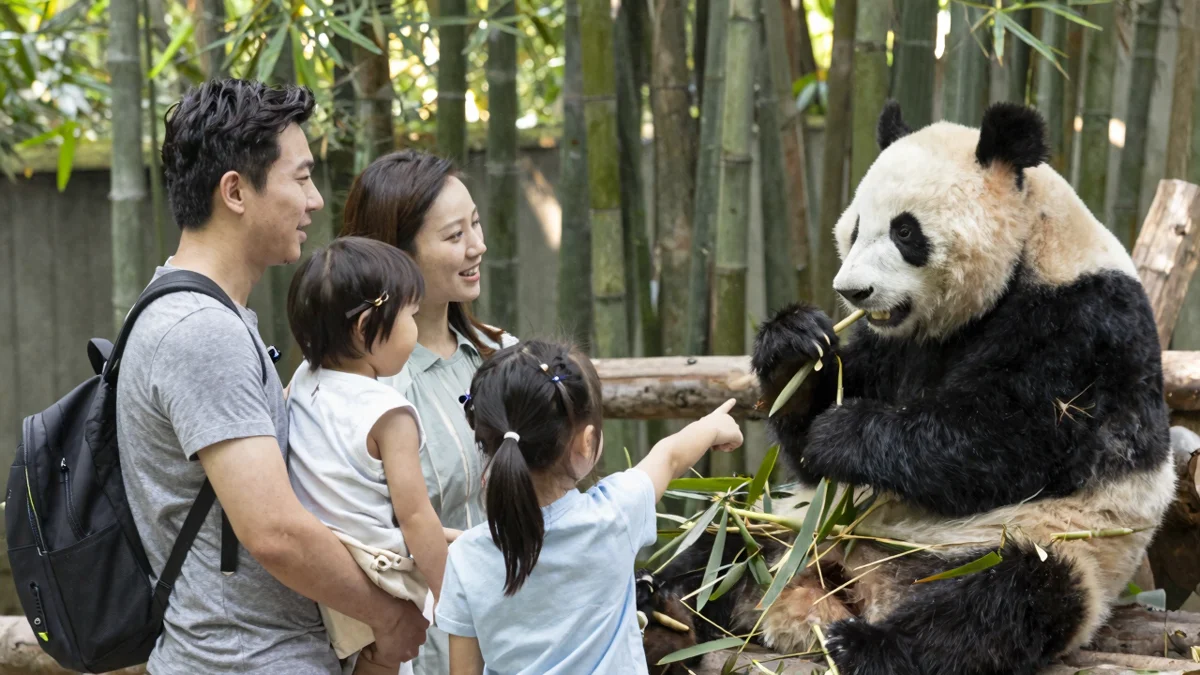
The Panda Experience — Worth Every Penny
If your kids love animals, the Chengdu Panda Base is non-negotiable. Get there when it opens at 7:30am — that’s when the pandas are most active, eating their morning bamboo. By 10am most of them are asleep, and so is the magic.
Practical tips:
- ¥55 / ~$7.50 per adult, free for kids under 1.3m
- Hire a golf cart (¥20) — the base is huge and little legs get tired
- The “Panda Kindergarten” (panda cub nursery) is the highlight — timing varies
- Bring snacks and water — food options inside are limited and overpriced
Night Markets: Sensory Wonderland for Kids
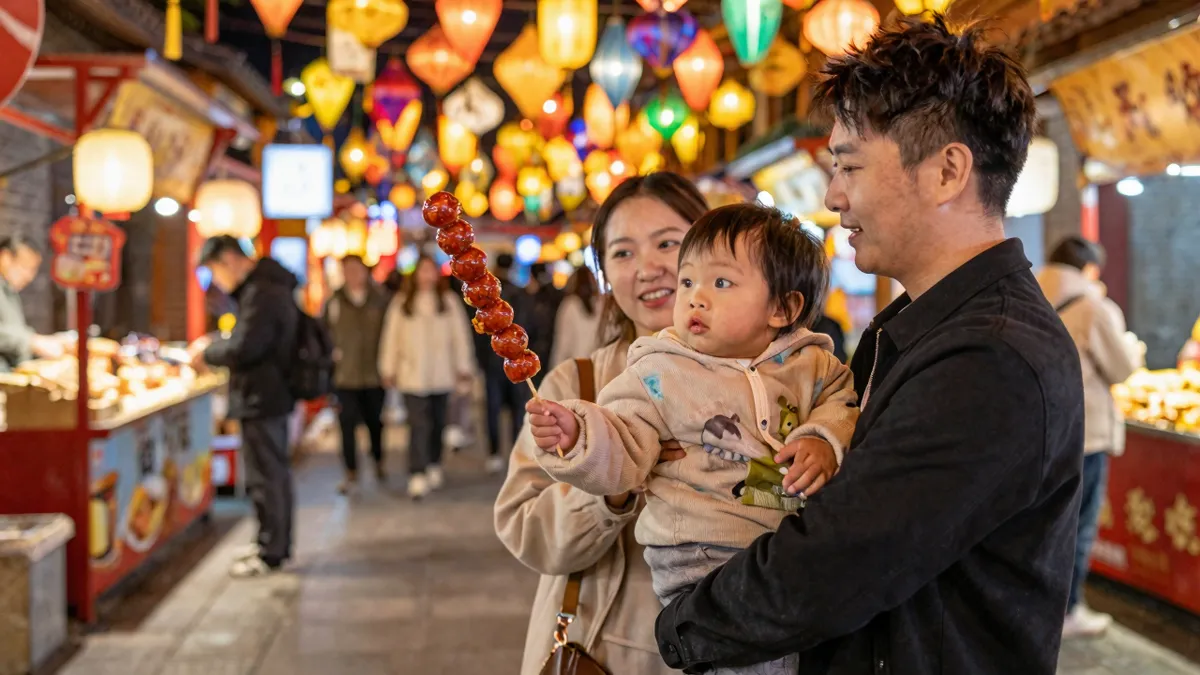
Chinese night markets are my kids’ absolute favorite thing about China. The noise, the smells, the glowing lanterns, the endless stream of people — it’s overwhelming in the best way. Every night market has a section of kid-friendly food: candied hawthorns on a stick (bingtanghulu), grilled corn on the cob, eggs wrapped around sausages, and fresh-squeezed sugarcane juice.
Pro tips:
- Go early (6-7pm) before the serious drinking crowd shows up around 9pm
- Bring wet wipes — things get sticky
- Let your kid pick one toy/gift from the market — kids’ toys are dirt cheap and negotiating is part of the fun
The Great Wall Toboggan
This is the kind of thing that makes kids think China is the coolest place ever. At Mutianyu Great Wall, instead of taking the cable car down, you can ride a 1.5km-long toboggan slide that winds through the forest. My daughter (7) still talks about it two years later.
⚠️ Parent note: Kids under 3 can ride with an adult. Kids 3+ ride their own sled (it has a brake lever — easy to control). My wife was nervous but even our then-5-year-old managed fine.
🧳 What to Pack (and What NOT to Pack)
Essentials You Might Not Think Of
| Item | Why You Need It |
|---|---|
| Reusable chopsticks + fork/spoon | Some smaller restaurants only have chopsticks |
| Sun hat + UV-protective clothing | China sun is STRONG, even in spring/autumn |
| N95 kid masks | Air quality can be poor — check AQI apps daily |
| Portable potty seat | Squat toilets are everywhere and hard for little kids |
| Hand sanitizer | Not always available in public restrooms |
| Familiar snacks | For meltdown prevention when unfamiliar food hits a wall |
| Earplugs/noise-canceling headphones | Cities are LOUD — construction, traffic, announcements |
| Travel-sized laundry sheets | Pack light, wash in hotel sinks |
| Children’s Pepto-Bismol or equivalent | Stomach issues happen — bring what works for YOUR kid |
| Water bottle with filter | Reduces plastic waste and gives peace of mind |
What NOT to Bring
| Don’t Bring | Why | Alternative |
|---|---|---|
| Bulky stroller | China has lots of stairs | Lightweight umbrella stroller + carrier |
| Large diaper stock | Good brands (Huggies, Pampers) available everywhere | Pack 3 days’ worth, buy locally |
| Baby formula from home | International brands widely available | Unless your kid needs a specific rare brand |
| Too many toys | Kids find Chinese toys fascinating | Let them pick a cheap toy at a night market |
| Heavy guidebooks | Google Maps doesn’t work here | Use Amap (高德地图) on your phone |
Diapers & Baby Supplies in China
| Product | Availability | Price Range | Brand Notes |
|---|---|---|---|
| Diapers (尿不湿) | ✅ Everywhere | ¥50-150/pack | Pampers, Huggies, local brands (Miaow, Babycare) |
| Wipes (湿巾) | ✅ Everywhere | ¥5-20/pack | Available at every convenience store |
| Baby shampoo | ✅ Major cities | ¥20-60/bottle | Johnson & Johnson widely available |
| Changing facilities | ⚠️ Limited | Free | Major malls have them; smaller restaurants don’t |
| High chairs | ⚠️ Inconsistent | Free | International restaurants = yes, local = maybe |
🏪 Staying Comfortable
Hotels: What to Look For
| Feature | Why It Matters | How to Find It |
|---|---|---|
| Family room | Some hotels offer rooms with bunk beds, play areas | Filter on Trip.com or Ctrip |
| Western breakfast buffet | Kid-friendly options like cereal, milk, bread | International chains (Hilton, Marriott, Holiday Inn) |
| Washing machine | Kids get dirty fast | Serviced apartments (check on Airbnb-like platforms) |
| Air purifier | Smog can be bad in winter | Ask hotel in advance — many will put one in the room |
| Near hospital | Peace of mind | Check on Amap before booking |
Bathrooms & Squat Toilets
This is a real issue for parents of toddlers. Here’s the reality:
- Most public restrooms (including metro stations, malls, parks) have squat toilets
- International hotels, airports, and high-end malls have Western toilets
- Malls and large attractions often have a “disabled/family” bathroom with a Western toilet
My survival tips:
- Keep a portable potty seat in your day bag
- Teach older kids the “squat technique” before you go
- Always carry tissues — TP is rarely provided outside hotels
- Hand sanitizer is your best friend
Weather & When to Go
| Season | Kid-Friendly? | What to Prepare |
|---|---|---|
| Spring (March-May) | ⭐⭐⭐⭐⭐ Best season | Mild temps, cherry blossoms, light layers |
| Summer (June-August) | ⭐⭐⭐ | Hot, humid, rainy — plan indoor activities midday |
| Autumn (September-November) | ⭐⭐⭐⭐⭐ Best season | Gold foliage, comfortable temps, low AQI |
| Winter (December-February) | ⭐⭐⭐ | Northern cities very cold, southern ones mild — Beijing/Shanghai 0-10°C |
⚠️ Avoid Chinese public holidays if possible: Spring Festival (Jan/Feb), Golden Week (Oct 1-7). Everything is insanely crowded. If you must travel during these times, book everything 2+ months in advance.
📱 Essential Apps for Traveling with Kids in China
| App | Why Parents Need It | Setup Before Arrival? |
|---|---|---|
| WeChat (微信) | Communication, payment, booking everything | ✅ Yes |
| Alipay (支付宝) | Mobile payment, Didi (ride-hailing), health codes | ✅ Yes |
| Amap (高德地图) | Navigation, public transit, POIs in English | ✅ Yes |
| Didi (滴滴) | Ride-hailing with child seat options | ✅ Yes |
| Trip.com | Train/flight/hotel booking in English | ✅ Yes |
| Xiaohongshu (RedNote) | Search “Beijing with kids” for real parent tips | Optional |
| Pleco | Chinese-English dictionary with camera translation | ✅ Yes |
| AirVisual | Real-time AQI monitoring | ✅ Yes |
💡 Full setup guide: For step-by-step instructions on WeChat, Alipay, eSIM and VPN, check our Internet Guide and Essential Apps Guide.
💰 Budget: How Much Will a Family Trip Cost?
Here’s a realistic daily budget for a family of 4 (2 adults + 2 kids) traveling moderately:
| Item | Budget (¥/day) | Budget ($/day) | Mid-Range (¥/day) | Mid-Range ($/day) |
|---|---|---|---|---|
| Hotel (family room) | 300-500 | $40-70 | 600-1200 | $80-170 |
| Food (3 meals) | 200-300 | $28-42 | 400-600 | $56-84 |
| Attractions (2 sites) | 100-200 | $14-28 | 200-400 | $28-56 |
| Transport (within city) | 50-100 | $7-14 | 100-200 | $14-28 |
| Snacks/water/extras | 50-100 | $7-14 | 100-200 | $14-28 |
| Total | 700-1200 | $98-168 | 1400-2600 | $196-364 |
Example: Budget 7-day trip to Shanghai + Beijing
- Flights: varies wildly by origin
- Accommodation: ¥3500-7000 ($490-980)
- Food: ¥2100-3500 ($294-490)
- Attractions: ¥1000-2000 ($140-280)
- High-speed rail (Shanghai↔Beijing): ¥1200 ($168) for 2 adults (kids under 1.2m free)
- Local transport: ¥500-1000 ($70-140)
- Estimated total: ¥8300-14500 ($1162-2030) excluding flights
⚡ Cultural Tips That Actually Matter
The Hot Water Thing
You’ll notice Chinese parents give their kids hot water (热水 rè shuǐ) to drink — even in summer. It’s a cultural thing rooted in traditional Chinese medicine (cold is bad for the stomach, they believe). You don’t HAVE to follow this, but you’ll find hot water dispensers everywhere — in train stations, hotel lobbies, restaurants. They’re great for making baby formula on the go.
Naptime Negotiations
Chinese cities don’t really do “quiet hours.” Construction can start at 7am, street vendors blare music at noon, and neighbors might practice the erhu at 10pm. If your kid is a light sleeper:
- Book a room on a high floor (above 15th floor = significantly quieter)
- Bring noise-canceling headphones for your kid
- White noise apps are lifesavers
- Plan naps to avoid the noisiest parts of the day
The Crowd Reality
Chinese tourist attractions can get genuinely overwhelming. The Great Wall during October Golden Week? You’ll be shuffling shoulder-to-shoulder. Shanghai Disney on a weekend? 2-hour waits are normal.
My strategy:
- Visit major attractions on weekdays only
- Arrive at opening time (often 7:30-8:00am)
- Eat lunch at 11:00am (before the crowds descend at 12:00)
- Take a midday break at the hotel during peak heat/crowds (2:00-4:00pm)
- Have a backup indoor plan for rain days
Tipping
Don’t tip. Seriously. It’s not expected and sometimes refused. The service charge is included in the bill. If you try to tip a taxi driver, they’ll look confused.
❓ FAQ
Can I bring baby formula into China?
Yes. Powdered formula is fine in checked luggage. Just declare it if asked. Ready-to-feed liquid formula might be an issue at security — stick to powder.
Is China safe for kids?
Statistically, very safe. Violent crime is extremely low. The main risks are traffic (crossing streets is chaotic), food safety (choose busy restaurants), and respiratory issues during smoggy days.
Do I need a VPN for my kids to watch YouTube/Netflix?
Yes. The Great Firewall blocks Google (and YouTube), Netflix, Instagram, Facebook, and many other services. Setup your VPN BEFORE you leave, since most VPN provider websites are also blocked in China. See our Internet Guide for details.
Are there breastfeeding rooms in China?
In major cities, yes. Large malls, airports, and train stations have nursing rooms (母婴室 mǔyīng shì — literally “mother-baby room”). They vary in quality — some have changing tables and private cubicles, others are just a chair behind a curtain.
My kid has a peanut allergy — how dangerous is China?
It’s a genuine concern. Peanut oil is very common in Chinese cooking. You’ll need to be vigilant and communicate clearly. Write a Chinese allergy card (get one translated professionally) and show it at every restaurant. Stick to well-known chains initially.
Can my kid drink the milk in China?
Pasteurized milk is safe and widely available. Major brands (Yili, Mengniu) follow international safety standards. UHT milk (shelf-stable) is very common and safe.
What if my kid gets sick at 2am?
Call 120 (ambulance) — they will take you to the nearest hospital’s emergency department. Major cities have 24-hour pharmacies too (look for the green cross). International hospitals have 24-hour hotlines.
Will my picky eater survive on rice and noodles?
Yes, absolutely. Rice (米饭) and plain noodles (面条) are available at practically every restaurant. Fried rice (蛋炒饭) is universal kid comfort food. You won’t need to search hard.
Is it worth visiting Shanghai Disney?
Yes, especially if you’re already in Shanghai. It’s smaller than the others (no Star Wars land, for example) but significantly less crowded — average wait times are 20-40 minutes even on weekends. The TRON Lightcycle Power Run is genuinely excellent. Tickets are ¥475 adult, ¥356 child (3-11).
🏁 The Bottom Line
Traveling in China with kids isn’t always easy, but it’s absolutely worth it. The country is incredibly kid-friendly in ways that surprised me — from strangers helping with strollers on stairs to restaurant staff making special non-spicy versions of dishes for my daughter.
The three things I’d tell any parent before their first trip:
- Pack light — buy diapers, wipes, and snacks when you arrive
- Plan one activity per day — not three. Everything takes longer with kids in China.
- Say yes to strangers — when a grandma wants to chat with your kid or a shopkeeper offers them a candy, let it happen. These small human connections are what make China special.
Related guides in this series:
- Visa & Entry Guide — Getting your family into China
- Health & Emergency Guide — Medical care, insurance, emergency contacts
- Essential Apps Guide — All the apps you need before arriving
- Internet Guide for China — eSIM, VPN, staying connected
- Transportation Guide — Getting around with kids
Last updated: July 2026 • Written by a parent, for parents