Potala Palace: The Sacred Fortress on the Roof of the World 🏔️🏯
📅 Version 1.0 | 📍 Lhasa, Tibet Autonomous Region, China | ⏱️ 2–3 hours
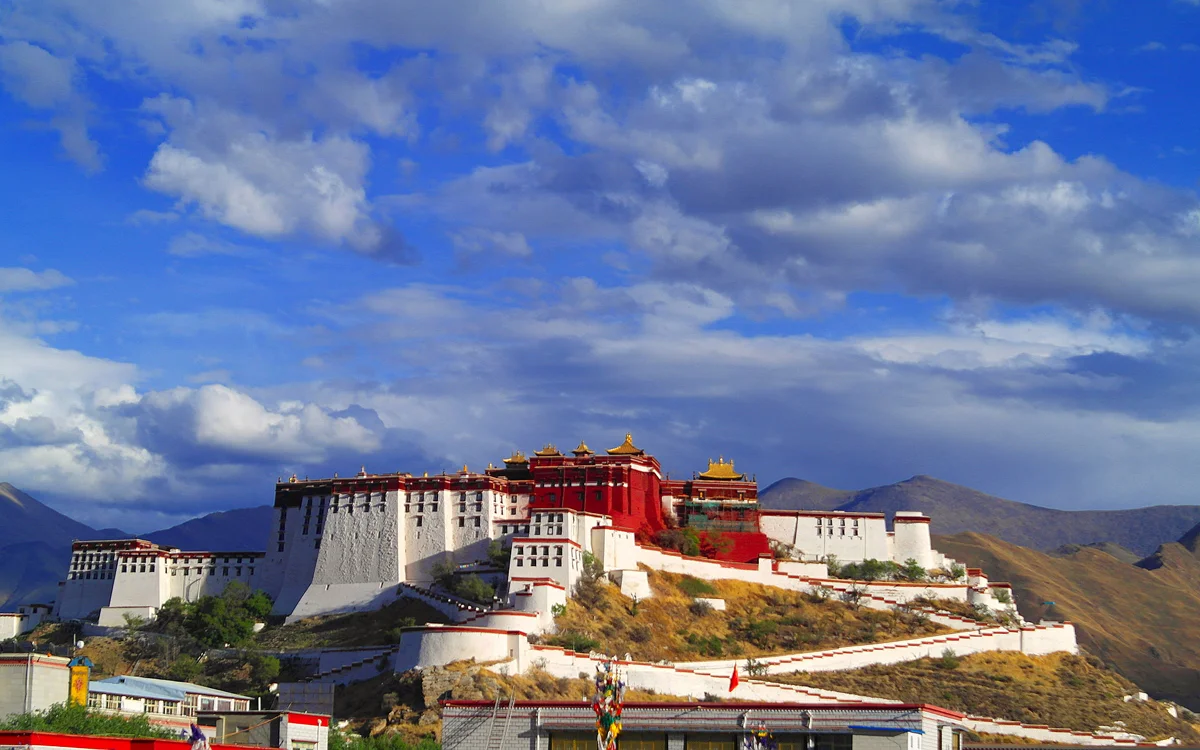
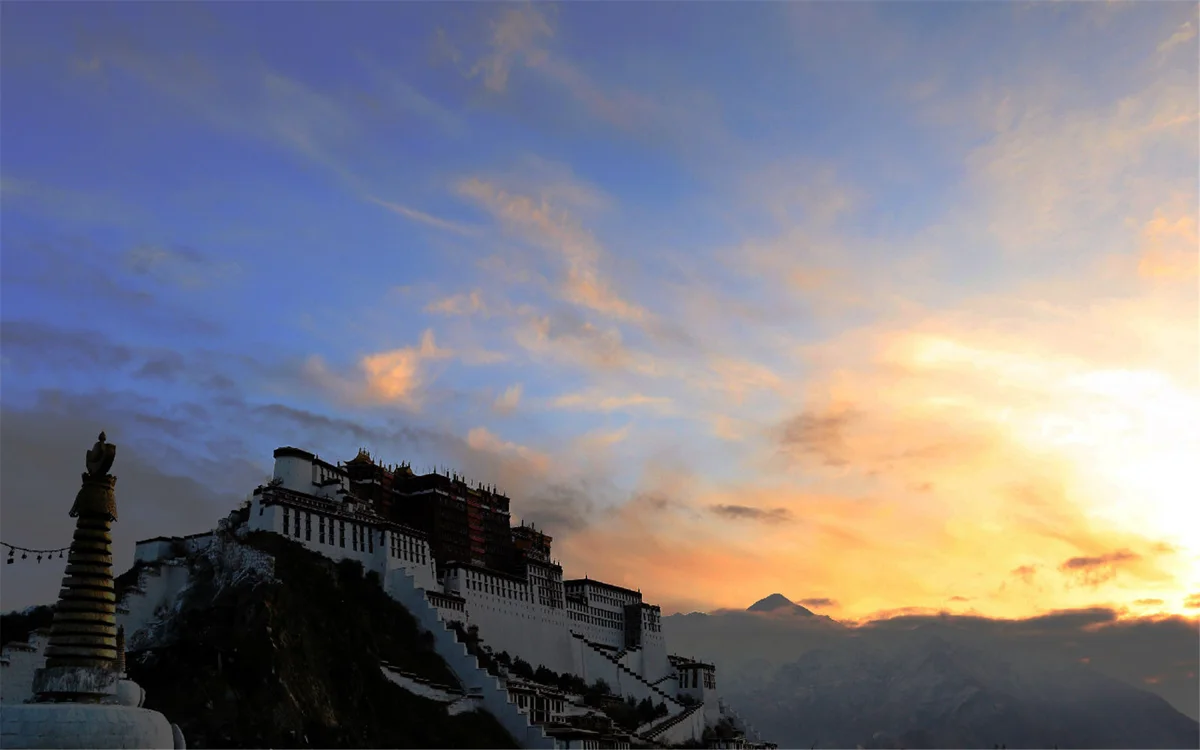
There is a building that has watched over the Tibetan plateau for over thirteen centuries. It clings to the face of a mountain like a prayer flag caught mid-flutter — white walls blazing in thin alpine light, red central towers crowned with golden roofs that catch the first and last rays of every sun. For most of its history, the Potala Palace was off-limits to all but monks, officials, and the Dalai Lamas themselves. Today, it receives over a million visitors a year, yet it has lost none of its gravity.
Standing at the base of Red Hill in Lhasa, craning your neck upward at 1,000 rooms spread across thirteen floors, you begin to understand why the Tibetans call it simply the Potala — a name that carries the weight of a civilization.
◆ A Fortress Born from Vision
The story of the Potala begins not with architecture, but with a love story. In the seventh century, the Tibetan emperor Songtsen Gampo married Princess Wencheng of the Tang Dynasty. To welcome her — a devout Buddhist from a land of palaces and temples — he built a palace on Red Hill. That original structure, completed around 637 AD, was modest by later standards, but it planted a seed.
For centuries, the palace was damaged by lightning, war, and neglect. By the time the fifth Dalai Lama, Ngawang Lobzang Gyatso, ascended to power in the mid-1600s, only the Potrang Karpo — the White Palace — remained standing. In 1645, he commissioned the construction of the Red Palace, the spiritual heart of the complex. Construction took until 1694, nearly half a century after his death. His successors added golden roofs, tomb stupas, and mural cycles that would take generations to complete.
The result is not a single building but a palimpsest — layer upon layer of Tibetan history inscribed in stone, gold, and pigment.
◆ The White Palace: Where Power Resided
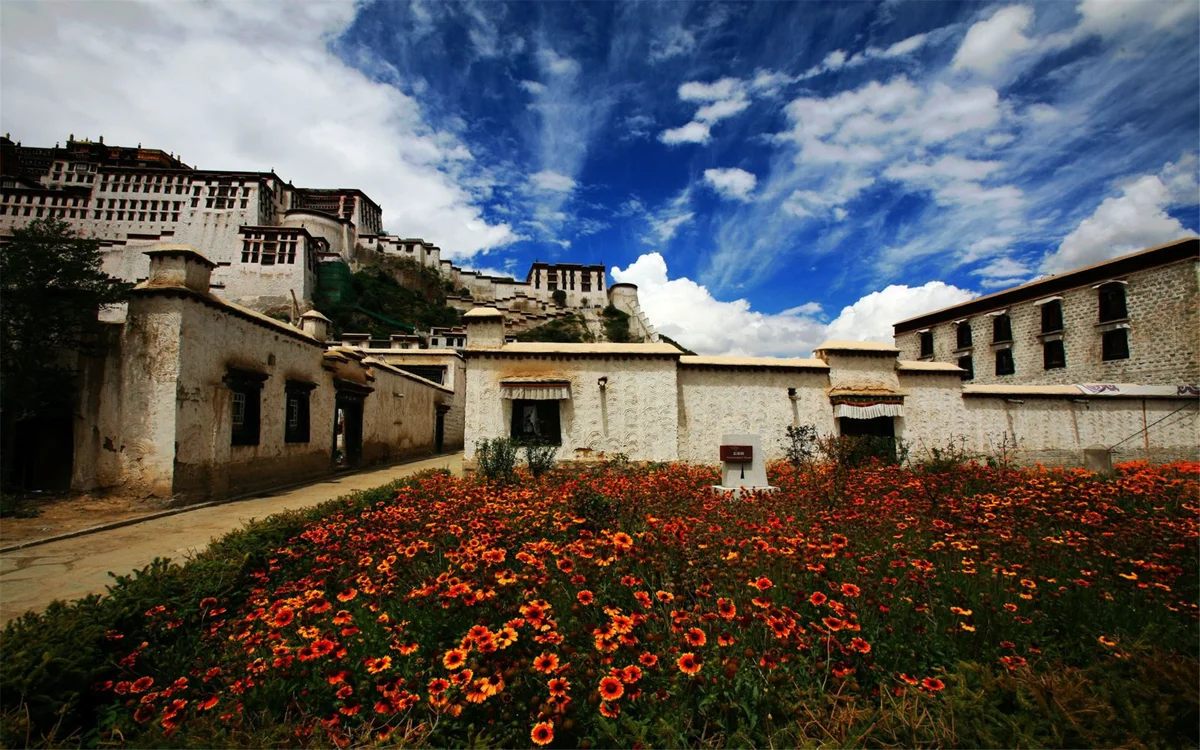
The Potrang Karpo — the White Palace — served as the administrative and residential core of the Potala. Its whitewashed walls, which must be repainted annually with a mixture of lime, sugar, milk, and honey, rise in a great truncated pyramid from the hillside.
Inside, the halls are vast and austere. The East Sunshine Hall (Dong Rijian) was the formal throne room of the Dalai Lama, where he received dignitaries and conducted state business. The ceiling stretches high overhead, supported by massive wooden beams that rest directly on the stone walls — no steel, no nails, no modern engineering. The West Sunshine Hall served as the private living quarters, its rooms cool even in summer, lit by small windows that frame the city below.
The assembly halls of the White Palace could hold thousands of monks during religious festivals. The scale is deliberately overwhelming — you are meant to feel small before the authority housed here.
◆ The Red Palace: Where the Sacred Dwells
The Potrang Marpo — the Red Palace — is the spiritual nucleus of the entire complex, and it is here that the Potala’s deepest treasures lie. Painted a deep crimson that contrasts sharply with the surrounding white walls, the Red Palace contains the chapels, the reliquary stupas, and the most sacred objects of Tibetan Buddhism.
No photography is permitted inside the Red Palace, and the prohibition is strictly enforced. What you carry away must be memory alone: the smell of butter lamps and juniper incense, the whisper of prayer wheels being spun by weathered hands, the overwhelming gold of the stupa halls catching flickering lamplight.
Eight of the fourteen Dalai Lamas who have held the title are entombed here in gilded stupas — towering reliquary monuments that rise through multiple floors, each one a universe of gold, silver, jade, and coral.
◆ The Stupa Tombs: Gold Beyond Imagination
The most famous of these is the stupa of the fifth Dalai Lama, the “Great Fifth” who unified Tibet and began the Potala’s construction. His reliquary stands 14.85 meters tall and is covered in 3,721 kilograms of gold. Embedded within its surface are more than 10,000 pearls, diamonds, rubies, emeralds, sapphires, and pieces of coral and amber. It took over 100,000 workers and artisans three years to complete.
The stupa of the thirteenth Dalai Lama, Thubten Gyatso, who modernized Tibet in the early twentieth century, is equally magnificent though somewhat smaller. The contrast between the two is a quiet lesson in how Tibetan art evolved — from the exuberant Baroque of the fifth to the more restrained, refined style of the thirteenth.
Walking between these stupas in the near-darkness of the Red Palace, lit only by the warm glow of butter lamps, you understand something that guidebooks rarely convey: this is not a museum. It is a place where the dead are still present.
◆ The Murals: A Library in Paint
Over 698 murals cover the interior walls of the Potala, forming one of the largest and best-preserved collections of Tibetan Buddhist painting in the world. They depict the life of the Buddha, the history of Tibetan Buddhism, the construction of the Potala itself, and the cosmic geography of Tibetan cosmology.
The murals of the Shambhala Chapel show the mythical kingdom of enlightened beings in vivid detail — concentric rings of mountains, jeweled palaces, armies of wrathful deities. The painting technique is traditional mineral pigment on plaster, applied in thin layers that give the colors a luminous depth. Some murals incorporate real gold leaf, which glows when touched by candlelight.
A word of caution: the murals are fragile. Centuries of smoke from butter lamps have darkened many of them. Restoration work is ongoing, and certain chapels are occasionally closed to protect the most delicate panels.
◆ Architecture Without Steel
The Potala Palace is an engineering marvel that predates modern construction by centuries. It rises 117 meters from the base of Red Hill, its walls tapering inward at a deliberate angle that gives the structure its characteristic truncated pyramid shape. The walls themselves are extraordinary — some measure over two meters thick at the base, constructed of rammed earth, stone, and a traditional Tibetan building material called agaru (a mixture of clay, straw, and yak dung).
No steel beams were used anywhere in the original construction. The entire structure relies on a network of wooden pillars, beams, and brackets — a system that has proven remarkably resilient. The palace has survived earthquakes, and the wooden joints flex rather than snap under stress.
The golden roofs that crown the Red Palace are covered in gilded bronze tiles. During certain light conditions — particularly at dawn and dusk — they blaze like fire against the deep Tibetan sky, visible from across the Lhasa Valley.
◆ The Kora: Walking with the Pilgrims
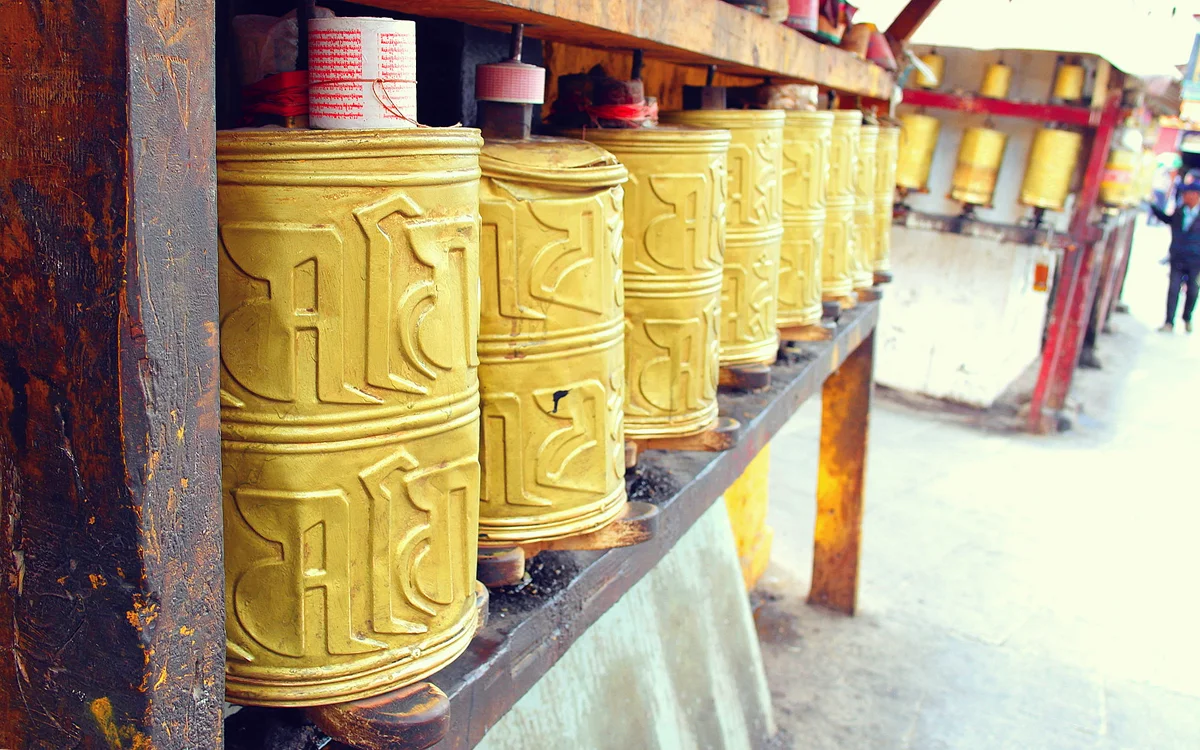
Before you enter the palace, walk the kora — the circumambulation route that circles Red Hill. Pilgrims have walked this path for centuries, and they walk it still. Early morning is the best time to join them. You will see elderly Tibetans spinning prayer wheels with one hand and counting malas with the other, their lips moving in silent mantras. Prostrations are common — pilgrims measuring the full length of the kora with their bodies, hands clasped above their heads, falling forward and rising again with a practiced grace that belies the physical toll.
Prayer flags stretch from the hilltop to the surrounding buildings in long diagonals, their five colors — blue, white, red, green, and yellow — representing sky, wind, fire, water, and earth. The wind carries the prayers printed on them outward into the world.
The kora route passes through a forest of juniper trees planted centuries ago, their branches hung with khata — white ceremonial scarves left by pilgrims as offerings. The air smells of juniper smoke and yak butter. It is, by any measure, one of the most atmospheric walks in Asia.
◆ Practical Information
Location: 35 Beijing Middle Road (北京中路35号), Chengguan District, Lhasa, Tibet Autonomous Region, China
◆ Getting There
Lhasa’s Gonggar Airport (LXA) receives flights from Beijing, Chengdu, Kunming, Xi’an, and several other Chinese cities. From the airport, the Potala Palace is approximately 60 kilometers west — about an hour by car. The Lhasa Railway Station, the terminus of the Qinghai-Tibet Railway, is about 10 kilometers south.
Within Lhasa, taxis are cheap and plentiful. Most rides across the city cost ¥10–20 (~$1.40–$2.80). The Potala Palace is also within walking distance of Barkhor Street and Jokhang Temple, forming a natural walking circuit through the historic core of the city.
◆ Altitude Awareness
Lhasa sits at 3,650 meters (12,000 feet). The Potala Palace itself is at 3,700 meters. Altitude sickness is a real concern, and you should plan to spend at least one full day acclimatizing before attempting the climb to the palace. Drink plenty of water, avoid alcohol on your first day, and move slowly. Most visitors adjust within 24–48 hours. If you experience severe headache, nausea, or difficulty breathing, descend immediately and seek medical attention.
◆ Opening Hours & Tickets
| Season | Dates | Price | Hours |
|---|---|---|---|
| Peak | May 1 – October 31 | ¥200 (~$28) | 9:00 – 16:00 |
| Off-peak | November 1 – April 30 | ¥100 (~$14) | 9:30 – 15:00 |
- Closed every Monday for maintenance.
- Time limit: You are given a 2-hour window inside the palace. Guards will begin ushering people out as the time approaches.
- Advance booking: In peak season, tickets sell out days in advance. Book through the official WeChat mini-program (搜索”布达拉宫”) at least 7 days ahead.
- Foreign visitors: You will need your passport at the entrance. No exceptions.
◆ Permits for Foreign Visitors
Foreign nationals require:
- Tibet Travel Permit (TTP) — issued by the Tibet Tourism Bureau. Must be arranged through a licensed Tibetan travel agency before arrival. This is non-negotiable.
- PSB Aliens’ Entry Permit — issued by the Public Security Bureau in Lhasa upon arrival. Your travel agency will handle this.
Important: You cannot purchase a Potala Palace ticket without a valid TTP. Plan well in advance — processing can take 2–4 weeks.
◆ Visitor Tips
- No photography inside the Red Palace. This is strictly enforced.
- Dress modestly — shoulders and knees covered. This is a sacred site, not a photo opportunity.
- Remove hats and sunglasses when entering any chapel.
- Follow the prescribed route. The interior is a one-way circuit; backtracking is not allowed.
- Carry a light jacket. Even in summer, the interior of the palace is cool, and the climb in thin air can leave you winded.
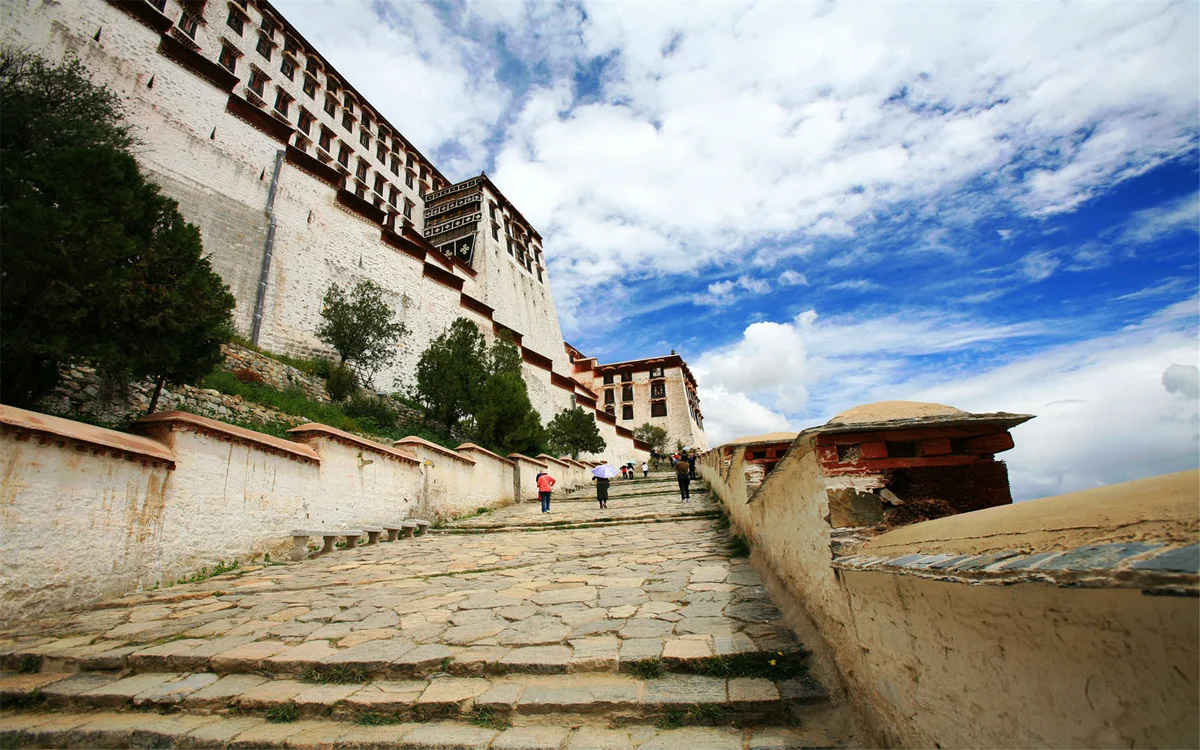
- Beware of altitude on the stairs. The climb from the base to the upper levels involves hundreds of steep stone steps. Take your time.
◆ Best Time to Visit
May through October offers the warmest weather, with daytime temperatures of 15–25°C (59–77°F). The shoulder months of May and October are ideal — fewer crowds than July and August, pleasant temperatures, and clear skies. Avoid Chinese New Year (January/February) and the Tibetan New Year (Losar, usually February/March), when the palace may be closed for celebrations and the city is packed.
Winter visits (November–April) have their own charm: lower ticket prices, thin crowds, and a stark beauty to the snow-dusted palace against bare mountains. But temperatures drop well below freezing, and some facilities may have reduced hours.
◆ Budget: Per Person, Per Day
| Category | Budget (¥) | Budget ($) | Notes |
|---|---|---|---|
| Potala Palace ticket | ¥200 | ~$28 | Peak season |
| Accommodation | ¥200–600 | ~$28–84 | Hostel to mid-range hotel |
| Meals | ¥80–200 | ~$11–28 | Tibetan restaurant to café |
| Local transport | ¥20–50 | ~$3–7 | Taxis within the city |
| Barkhor Street souvenirs | ¥50–200 | ~$7–28 | Prayer beads, thangkas, jewelry |
| Altitude medicine | ¥30–80 | ~$4–11 | Rhodiola, oxygen cans |
| Daily total | ¥580–1,130 | ~$81–158 |
Travel agency permits (TTP + logistics) typically add ¥300–800 (~$42–112) to your trip cost, depending on the agency and itinerary.
◆ Frequently Asked Questions
Q: How difficult is the climb to the top? The climb involves approximately 300–400 steep stone steps from the base to the upper levels. At 3,700 meters altitude, this feels significantly harder than it would at sea level. Most people manage it with frequent rest stops, but those with heart or respiratory conditions should consult a doctor beforehand. Porters with carrying poles are sometimes available at the base for ¥50–100.
Q: Can I buy tickets at the gate? In peak season (May–October), almost certainly not. Tickets are released online through the official WeChat mini-program and sell out within hours of release. Book at least 7 days in advance. In off-peak season, same-day tickets are sometimes available at the ticket office, but arriving early (before 9:00) is strongly recommended.
Q: Is photography allowed inside? Photography is permitted in some areas of the White Palace, but absolutely prohibited inside the Red Palace. Guards are vigilant, and using your phone camera in restricted areas may result in confiscation or a fine. The safest approach: put your camera away entirely once you enter the Red Palace.
Q: Do I need a guide? A guide is not required, but highly recommended — especially for foreign visitors. The palace’s history is complex and largely unmarked in English. Licensed guides can be arranged through your travel agency or at the palace entrance (¥100–200 / ~$14–28). Audio guides are also available in multiple languages.
Q: What is the difference between the White Palace and the Red Palace? The White Palace (Potrang Karpo) was the administrative and residential wing — the Dalai Lama’s living quarters, throne rooms, and government offices. The Red Palace (Potrang Marpo) was the spiritual center — chapels, reliquary stupas, and sacred libraries. Both are part of the same complex, and your ticket covers both. The Red Palace is smaller but contains the most important religious treasures.
Q: Can I visit Lhasa independently, or do I need a tour group? Independent travel in Tibet is possible but requires more planning than elsewhere in China. Foreign visitors must arrange a Tibet Travel Permit through a licensed agency, and while you are not required to travel with a group after arrival, the permit process itself necessitates agency involvement. Some areas outside Lhasa require additional permits and a registered vehicle with a driver. For the Potala Palace and central Lhasa, independent exploration is perfectly feasible once your permits are in order.
The Potala Palace is not merely a building. It is a mountain that learned to pray.