Guizhou Explorer: Minority Villages & Huangguoshu Falls
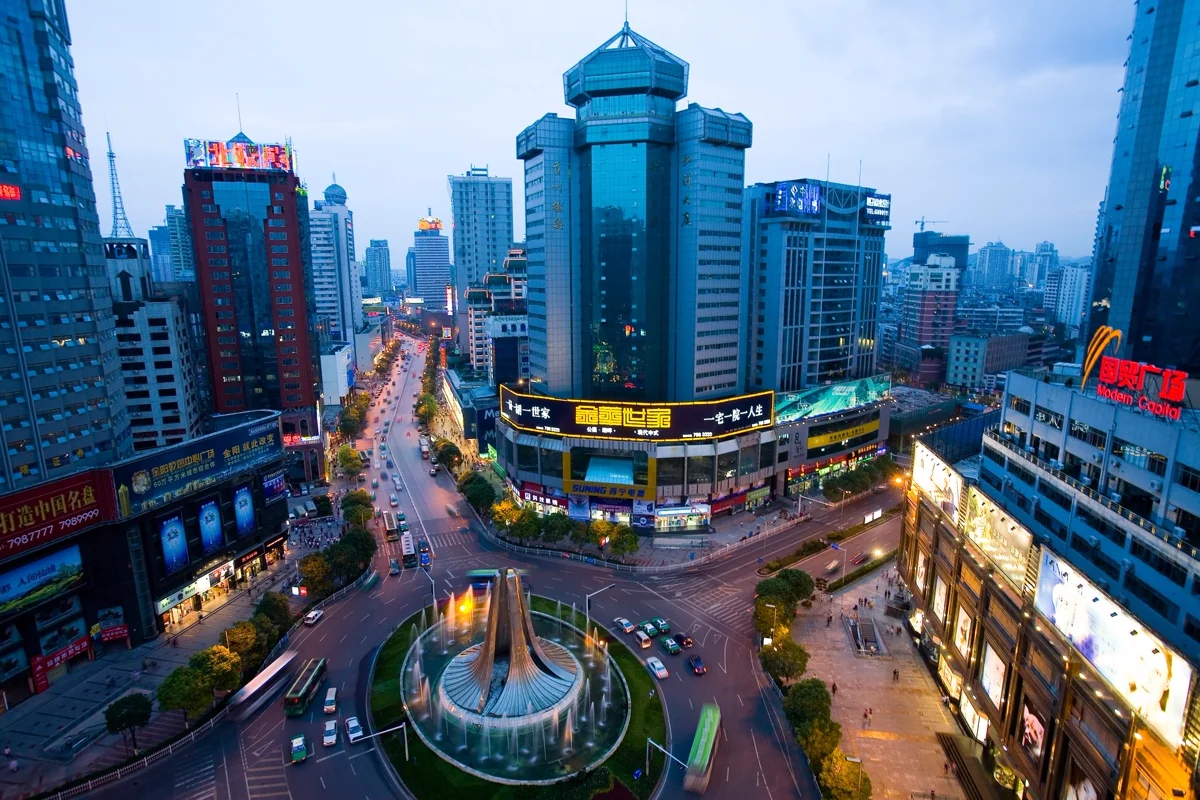
◆ Guizhou has long been one of China’s most underrated provinces. Tucked away in the mountainous southwest, it is a land of vertiginous karst peaks, cascading waterfalls, and deep river valleys. But what truly sets it apart is its human geography: over a third of its population belongs to one of China’s 55 officially recognised ethnic minorities, among them the Miao, Dong, Buyi, and Yi peoples. For the traveller who has already done the Beijing–Shanghai–Xi’an circuit, Guizhou offers something rawer, less polished, and infinitely more surprising.
The province’s unofficial capital, Guiyang, serves as the logical launchpad. A sprawling modern city ringed by forested hills, it offers few blockbuster attractions of its own but functions as a transit hub for the region’s true treasures: the thunderous Huangguoshu Waterfall, the fantastical wooden villages of the Miao highlands, and the stone-paved alleyways of Qingyan Ancient Town. This guide unpacks each of these destinations in detail, with practical information for the independent traveller.
「黄果树瀑布」China’s Most Powerful Cascade
No trip to Guizhou is complete without standing in the spray of Huangguoshu Waterfall. At 77.8 metres high and 101 metres wide, it is the largest waterfall in East Asia and arguably the most spectacular cascade in all of China. The name means “Yellow Fruit Tree”, a reference to the local abundance of a wild fruit that resembles a small orange.
The experience begins long before you see the falls. From the entrance, a winding pathway follows the Baishui River through a lush riparian forest thick with bamboo and banyan trees. The roar grows steadily louder, until you round a corner and the full curtain of water reveals itself. During the rainy season — June through October — the flow is at its most ferocious, sending up a plume of mist that can be seen from kilometres away and creating near-permanent rainbows on sunny afternoons.
One of Huangguoshu’s most remarkable features is the Water Curtain Cave (Shuiliandong), a 134-metre natural tunnel carved into the rock behind the waterfall. Walking through it, you find yourself separated from the thundering water by only a thin veil of limestone. The view outward, through the cascading curtain, is one of those rare travel moments that photographs can never quite capture.
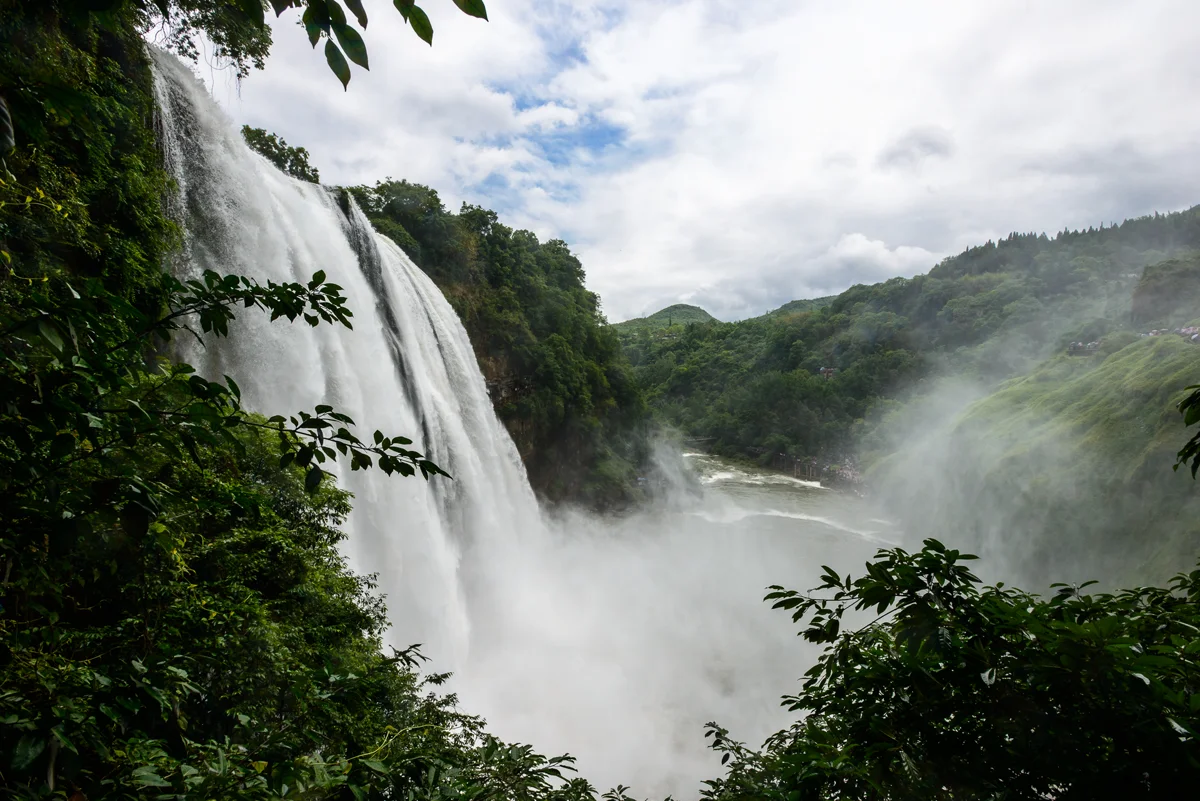
✦ Huangguoshu Waterfall
| Address | Huangguoshu Town, Zhenning Buyi and Miao Autonomous County, Anshun, Guizhou |
| Transport | 2-hour bus from Guiyang Jinyang Bus Station (¥55 / $8); high-speed train Guiyang North→Anshun West (30 min, ¥47 / $21) off-peak; Sightseeing elevator: ¥50 (~$7) extra |
| Rating | ★★★★★ |$7) + local bus |
| Hours | 8:00 – 18:00 (peak season Apr–Oct); 8:30 – 17:00 (off-peak) |
| Fee | ¥160 ($22) peak season; ¥150 (
#nature #waterfall #photography #landmark #hiking
The scenic area comprises three distinct zones: the main waterfall itself, the narrower Doupotang Waterfall upstream (where the river drops over a series of stepped rocky terraces), and the Silver Chain Waterfall downstream, a delicate fan-shaped cascade that spreads across a broad rock face. A full visit requires at least four to five hours, including the walk through the Water Curtain Cave and the ascent to the viewing pavilion on the opposite bank.
◆ Editor’s Note: Visit early in the morning, ideally before 9 a.m., to avoid the tour-bus crowds. The light at this hour also yields the best rainbows. Raincoat not optional but essential — the mist soaks everything within fifty metres of the falls.
「西江千户苗寨」The Thousand-Household Village
Perched on a hillside in the Leigong Mountains of southeastern Guizhou, Xijiang Qianhu Miao Village is the largest and most famous Miao settlement in China. “Qianhu” means “a thousand households”, and the name is not an exaggeration — the village spreads across two facing hillsides in a breathtaking assembly of dark-wood stilt houses (diaojiaolou), their roofs layered like the scales of a sleeping dragon.
The approach to Xijiang is itself a spectacle. The road from Kaili winds through terraced rice paddies and steep forested valleys, with occasional glimpses of the village long before you arrive. At night, the scene is nothing short of magical: thousands of warm lights flicker across the hillsides, reflected in the river that runs through the valley below.
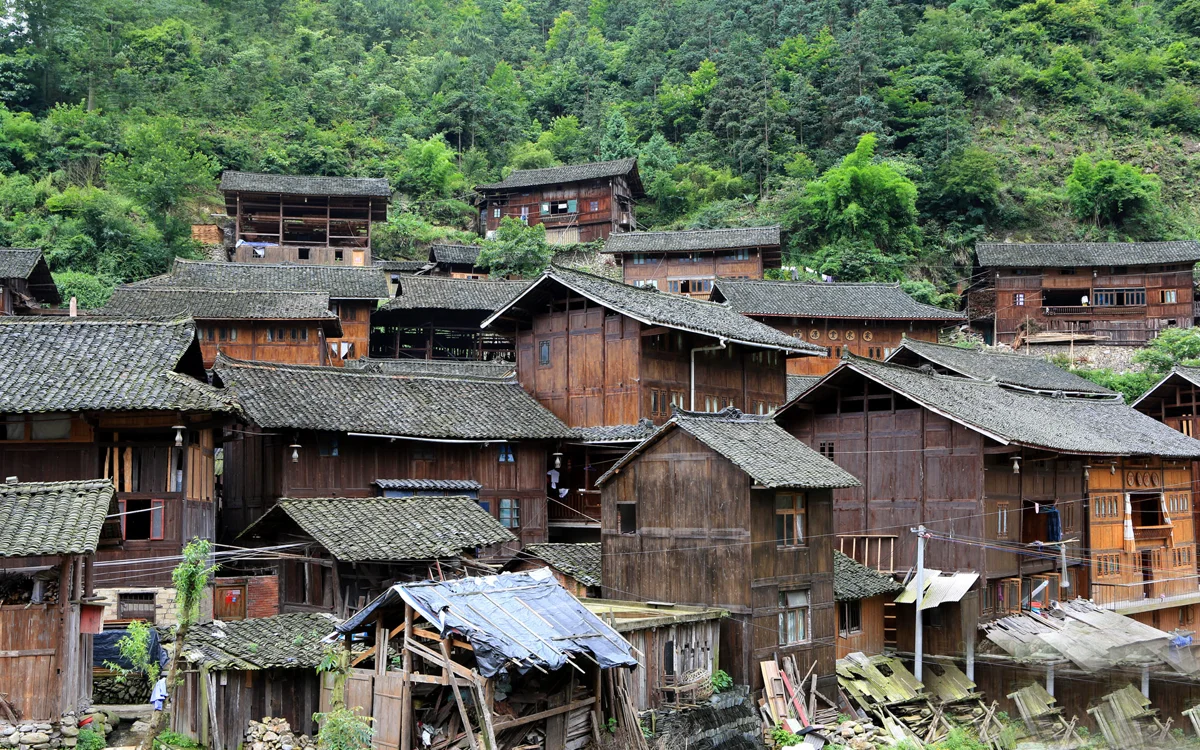
The village is not a museum; it is a living community. Some 6,000 Miao people reside here, and the daily rhythm of rural life continues alongside the tourist economy. In the mornings, women in indigo-dyed jackets and elaborate silver headpieces gather at the riverbank to launder clothes. Children chase one another through the narrow alleyways. Smoke rises from kitchen chimneys as families prepare breakfast over wood fires.
✦ Xijiang Qianhu Miao Village
| Address | Xijiang Town, Leishan County, Qiandongnan Miao and Dong Autonomous Prefecture, Guizhou |
| Transport | 3.5-hour bus from Guiyang Longdongbao Bus Station (¥90 / ~$13); 1-hour bus from Kaili (¥30 / $4); High-speed train Guiyang North→Kaili South (40 min, ¥58 / $6) evening entry (after 18:00, for lodging guests) |
| Rating | ★★★★★ |$8) + bus |
| Hours | Open 24 hours; the Miao Cultural Museum inside: 9:00 – 17:00 |
| Fee | ¥90 ($13) daytime; ¥45 (
#culture #minority #nightview #photography #architecture #traditions
The best vantage point for photography is the viewing platform at the top of the eastern hillside, accessible by a short hike or a ¥5 (~$0.70) shuttle. From here, the full sweep of the village unfolds. Sunset is the ideal moment, when the last rays paint the wooden facades gold and the first lights begin to appear in the windows below.
A few recommended experiences beyond the view: sit in on the evening Miao song-and-dance performance held in the central square (included in the admission fee); sample the village’s home-brewed rice wine served in ceramic bowls; and hire a local guide to take you to the terraced fields above the village, where the panorama of the valley is even more expansive.
◆ Editor’s Note: Many tour groups visit Xijiang as a day trip, staying only two or three hours. This is a mistake. The village reveals itself only after the day-trippers have departed. Book a room in one of the guesthouses on the eastern hill, watch the lights come on at dusk, and wake to the sound of roosters and running water. That is the real Xijiang.
「甲秀楼」The Pavilion That Anchors a City
Guiyang may lack the headline attractions of its larger Chinese cousins, but it has Jiaxiu Pavilion, and that is enough. Built in 1598 during the Ming Dynasty, this three-tiered wooden pagoda rises from the middle of the Nanming River, connected to both banks by the graceful Floating Jade Bridge.
The name “Jiaxiu” translates roughly to “First Scholar”, a reference to the hope that the pavilion would nurture scholarly talent in the region. Over the centuries it has become the emblem of Guiyang, appearing on everything from taxi doors to tourism posters.
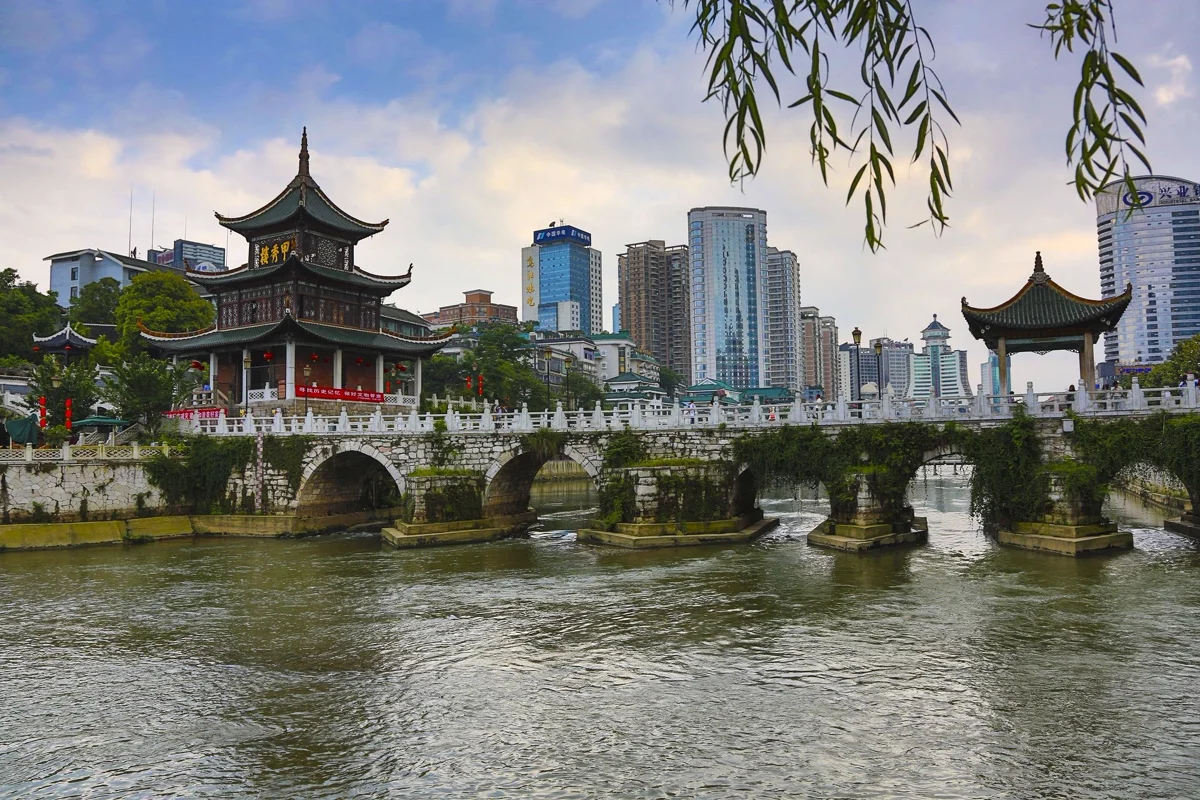
The pavilion itself is modest in scale — three storeys, a handful of galleries, a small exhibition on Guizhou’s history — but its setting is exquisite. By day, the Nanming River reflects the pavilion’s silhouette against a backdrop of modern apartment towers and tree-lined embankments. By night, the building is bathed in golden light, while the bridge arches across the water like a drawn bow.
✦ Jiaxiu Pavilion
| Address | South Bank of Nanming River, Nanming District, Guiyang | | Transport | Metro Line 1 to Zhongshan Road Station (Exit D), 10-min walk; or take any bus to Dusi Road stop | | Hours | 8:30 – 18:00 (summer); 8:30 – 17:30 (winter); exterior visible 24 hours | | Fee | ¥10 (~$1.50) for interior access; exterior and bridge free | | Rating | ★★★☆☆ |
#architecture #history #nightview #free #citylandmark
The surrounding park is equally pleasant. On warm evenings, local residents gather to practice tai chi, play Chinese chess under the willow trees, or simply fan themselves while watching the river flow by. A walk along the embankment at dusk, from the pavilion downstream to the Nanming Bridge, offers a gentle introduction to Guiyang’s urban rhythm.
◆ Editor’s Note: The ¥10 admission fee is almost not worth paying — the interior is sparse. The real attraction is the exterior, best seen at night when the pavilion is illuminated. Do not skip the twenty-minute stroll around the riverbanks.
「花溪公园」A River Runs Through It
A short bus ride south of central Guiyang, Huaxi Park is a sprawling riverside green space that the city’s residents treat as their collective backyard. The name means “Flowering Stream”, and the park delivers on its promise: a clear, shallow river runs the length of the grounds, flanked by weeping willows, peach trees, and patches of wildflowers that bloom from spring through autumn.
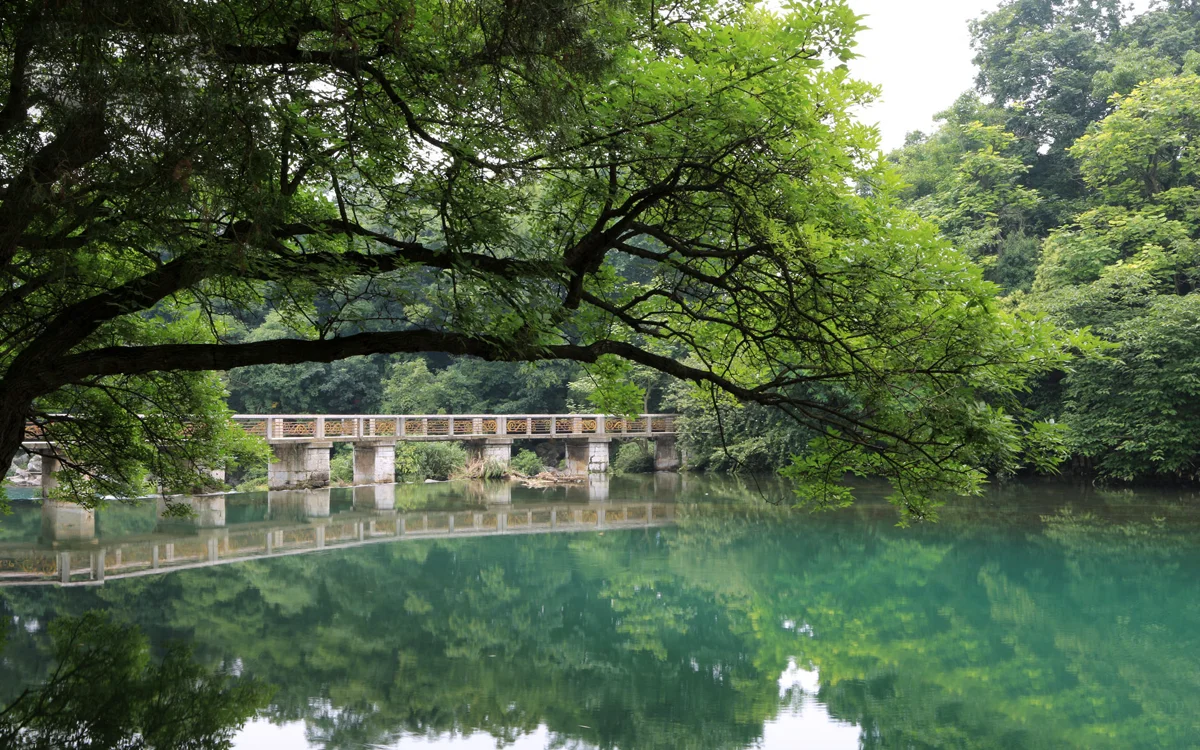
What makes Huaxi special is not any single landmark but the cumulative pleasure of its atmosphere. Families picnic on the grassy banks. Elderly men fish from the stone bridges. Students cycle along the shaded pathways. In summer, children wade into the river, their laughter rising above the sound of the current. It is a portrait of Chinese leisure as it was before the age of the smartphone.
✦ Huaxi Park
| Address | Huaxi District, Guiyang (south of city centre, along Huaxi Avenue) | | Transport | Bus 201, 202, or 204 from downtown Guiyang (40 min); or Metro Line 3 to Huaxi Park Station (Exit B), direct | | Hours | 7:00 – 22:00 daily | | Fee | ¥10 (~$1.50) for the main park; free before 8 a.m. | | Rating | ★★★★☆ |
#nature #park #river #relaxation #free #family
Within the park, the Peach Blossom Ravine and the Pine Forest Slope are the highlights. The former is best visited in March when the trees are in full bloom; the latter provides shade even on the hottest summer afternoons. There is also a small lake with pedal boats available for hire (¥30 / ~$4 per hour), though the real pleasure is simply walking — the park paths stretch for nearly three kilometres along the river.
◆ Editor’s Note: Go early on a Sunday morning to witness the amateur musicians and singers who congregate by the riverside pavilion. Erhu players accompany folk singers; aunties in matching outfits dance in formation. It is spontaneous, joyful, and utterly uncommercial.
「青岩古镇」Stone Walls, Quiet Alleys
Forty kilometres south of Guiyang, Qingyan Ancient Town offers a glimpse of Guizhou as it was in the Ming and Qing dynasties. Founded in 1378 as a military outpost, the town is built entirely of locally quarried bluestone — walls, streets, houses, even the rooftiles. The stone has aged to a warm grey, softened by patches of moss and lichen.
Unlike some of China’s more commercialised “ancient towns”, Qingyan maintains a genuine sense of habitation. Yes, there are souvenir shops and tourist restaurants, but there are also butchers cutting meat on wooden blocks, women embroidering Miao patterns on their doorsteps, and elderly men napping in the shade of the arched gateways.
✦ Qingyan Ancient Town
| Address | Qingyan Town, Huaxi District, Guiyang (40 km south of city centre) |
| Transport | Bus 210 from Huaxi Bus Station (50 min, ¥5 / $0.70); or metro Line 3 to Huaxi Park Station + taxi (¥30 / $1.50) for town entry only |
| Rating | ★★★★☆ |$4) |
| Hours | 8:30 – 17:30 daily |
| Fee | ¥60 ($8.50) for combined ticket (includes all interior temples and gate towers); ¥10 (
#history #architecture #culture #ancienttown #photography
The town is compact — the main loop walk takes about two hours — but the pleasure lies in getting lost. The side alleys are narrow and almost empty, leading to hidden courtyards, small temples, and unexpected viewpoints. The four original gate towers — East, South, West, and North — offer perspectives over the surrounding countryside, where rice paddies and vegetable fields stretch to the base of distant karst hills.
A local speciality not to be missed inside the town is qingyan doufu (青岩豆腐), a firm, smoky tofu that is grilled over charcoal and served with a dipping sauce of chilli, soy, and crushed peanuts. It costs ¥5 (~$0.70) for a skewer and makes for an excellent walking snack.
◆ Editor’s Note: The combined ticket includes entry to several small museums inside the town, but none of them is essential. Save your energy for the alleys and the climb up to the South Gate tower, which has the widest view of the surrounding farmland.
「黔味食单」A Culinary Detour Through Guizhou
Guizhou cuisine deserves far more attention than it receives. Overwhelmingly characterised by the use of sourness and chilli — often in tandem — it shares DNA with the cooking of neighbouring Yunnan and Hunan but maintains a distinct identity of its own.
The Sour Fish Soup (酸汤鱼 / Suān Tāng Yú)
This is Guizhou’s signature dish, and the one that lingers longest in memory. A whole freshwater fish — typically carp or grass carp — is simmered in a broth made from fermented glutinous rice and local tomatoes, resulting in a tangy, crimson soup with a depth that approaches the best tom yam of Thailand. The fish is served in a traditional metal pot over a small burner, kept bubbling at the table. The broth is drunk as a soup and used as a dipping base for vegetables and rice noodles.
Where to try: Laokai Li Sour Soup Fish (老凯里酸汤鱼), several locations in Guiyang, notably at Shengfeng Road near the city centre. Price: ¥80–120 (~$11–$17) per person.
Guizhou Rice Noodles (花溪牛肉粉 / Huāxī Niúròu Fěn)
While the neighbouring province of Yunnan claims guoqiao mixian as its own, Guizhou’s rice noodle culture is equally compelling. The local version, best sampled in Huaxi District, consists of finely ground rice noodles in a beef broth that has been simmered for hours with star anise, cassia bark, and ginger. Topped with thin slices of braised beef, fresh coriander, and a spoonful of fiery chilli oil, it is a breakfast that can change the course of a day.
Where to try: Huaxi Wang Ji Beef Noodles (花溪王记牛肉粉), Huaxi Avenue, near Huaxi Park. Price: ¥15–20 (~$2–$3) per bowl.
Other Notable Dishes
| Dish | Description | Where | Price |
|---|---|---|---|
| Changwang Noodles (肠旺面) | Pork intestine and blood curd in spicy broth with alkaline noodles | Any street stall in Guiyang | ¥12 (~$2) |
| Siwawa (丝娃娃) | “Silk Baby” — rice paper wraps filled with shredded vegetables, dipped in sour-spicy sauce | Erqi Road Night Market, Guiyang | ¥30 (~$4) for a set |
| Buckwheat Cake (荞麦粑) | Steamed sweet buckwheat cake, a Dong minority staple | Dong villages around Zhaoxing | ¥5 (~$0.70) |
| Chilli-infused everything | Guizhou pickles fresh chillies in salt and rice wine, eating them with almost every meal | Ubiquitous | — |
「苗银与苗绣」The Art of Adornment
To understand the Miao people is to understand their relationship with silver. In Miao culture, silver is not merely decorative — it is a store of wealth, a marker of social status, a talisman against evil spirits, and a bride’s most important possession. A full set of Miao festival silver can weigh up to fifteen kilogrammes and represents a family’s entire savings.
Xijiang Miao Village is the best place in Guizhou to observe and purchase Miao silver crafts. The main street is lined with workshops where silversmiths — often the fourth or fifth generation of their family — sit at small anvils, hammering, twisting, and soldering silver wire into elaborate headdresses, necklaces, earrings, and bracelets.
The craft is characterised by three techniques: cuoshuo (granulation), in which tiny silver beads are fused onto a surface; lei si (filigree), where fine silver wire is curled into floral and geometric patterns; and zhu ke (chasing), the art of engraving shallow relief designs. The result is a body of work that is simultaneously delicate and robust — a paradox that perfectly mirrors the Miao people themselves.
What to buy: Silver earrings (¥100–300 / ~$14–$42), simple bracelets (¥200–500 / ~$28–$70), or, for the committed collector, a traditional Miao headdress (¥1,500–5,000 / ~$210–$700).
Where to buy: Miao Silver Workshop Street, Xijiang Miao Village; Qingyan Ancient Town also has several reputable outlets.
◆ Editor’s Note: Beware of counterfeit “silver” that is actually nickel or zinc alloy. Authentic Miao silver is marked with a purity stamp (usually 925 or 990). Reputable workshops will demonstrate authenticity by rubbing the piece against a whetstone — real silver leaves a distinct metallic trace. Never buy from the hawkers who approach you on the street.
「行在黔中」Getting There and Getting Around
Arrival by Air
Guiyang Longdongbao International Airport (KWE) serves domestic flights from all major Chinese cities — Beijing (3 hours), Shanghai (2.5 hours), Guangzhou (1.5 hours), Chengdu (1 hour) — and a growing number of international routes from Southeast Asia and East Asia. A taxi from the airport to downtown Guiyang costs ¥50–70 ($7–$10) and takes 25 minutes. The metro (Line 1) connects the airport directly to the city centre for ¥6 ($0.85).
Arrival by Rail
Guiyang is a major node on China’s high-speed rail network. From Guangzhou, the journey takes 4.5 hours; from Changsha, 3 hours; from Chongqing, 2 hours; from Kunming, 2 hours. Guiyang North Station (Guiyang Bei) and Guiyang East Station (Guiyang Dong) are the two main HSR terminals, both connected to the city by Metro Line 1.
Getting to the Attractions
| Destination | From Guiyang | Duration | Cost |
|---|---|---|---|
| Huangguoshu Waterfall | Bus from Jinyang Bus Station or train to Anshun West | 2–2.5 hours | ¥55–105 (~$8–$15) |
| Xijiang Miao Village | Bus from Longdongbao Bus Station or train to Kaili South | 3–4 hours | ¥90–120 (~$13–$17) |
| Qingyan Ancient Town | Bus 210 from Huaxi | 50 minutes | ¥5 (~$0.70) |
| Huaxi Park | Metro Line 3 | 30 minutes | ¥6 (~$0.85) |
| Jiaxiu Pavilion | Metro Line 1 | 15 minutes | ¥6 (~$0.85) |
Best Time to Visit
The ideal period runs from April through October. June to October offers the fullest flow at Huangguoshu, but this is also the rainy season — expect afternoon downpours that clear as quickly as they arrive. March and November are quieter and still pleasant, though the waterfall is noticeably weaker. December through February is cold (5–10°C / 41–50°F) and overcast, with occasional snow in the mountains.
「预算速览」What It Costs
Guizhou is one of China’s most affordable provinces for domestic travel. A week-long trip, including accommodation, transport between cities, entry fees, and meals, can be managed on ¥3,500–4,500 ($480–$620) per person when travelling independently. Budget travellers could reduce this to ¥2,500 ($350) by opting for hostel dorms and street food.
| Item | Budget | Mid-Range | Splurge |
|---|---|---|---|
| Accommodation (per night) | ¥60–100 ($8–$14) | ¥150–300 ($21–$42) | ¥400+ ($55+) |
| Meals (per day) | ¥50–70 ($7–$10) | ¥100–150 ($14–$21) | ¥200+ ($28+) |
| Local transport (per day) | ¥20–50 ($3–$7) | ¥50–100 ($7–$14) | ¥150+ ($21+) |
| Attraction entry fees | ¥150–250 ($21–$35) | ¥200–350 ($28–$48) | ¥350+ ($48+) |
Editor’s Closing Note
Guizhou is not a destination for the traveller seeking the familiar comforts of first-tier China. The infrastructure can be rough around the edges. English signage is limited. The weather is mercurial. The food can test the tolerance of timid palates.
But these are precisely the qualities that make it worth visiting. In a country where so many tourist destinations have been polished into indistinguishable versions of themselves, Guizhou remains stubbornly, wonderfully itself. The Miao villages are not reconstructed for tourists — they have stood here for centuries. The waterfall does not need a light show to be spectacular. The mountains do not require cable cars to be admired.
Come for the cascade. Stay for the quiet hilltop village that, long after the tour buses have departed and the lights of a thousand households have flickered to life, will leave you with the rare and precious feeling of having discovered something genuine.