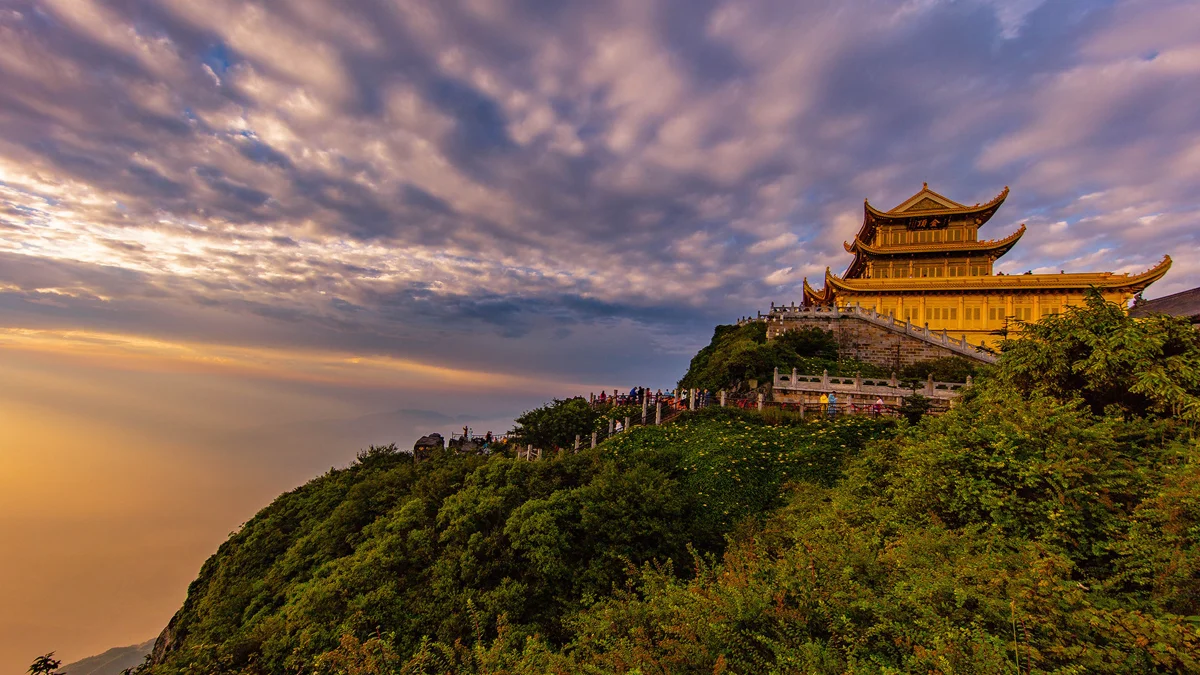
Mount Emei: Where Buddhism Meets the Clouds at 3,099 Meters 🪷🏔️
📅 A single-attraction deep dive | 📍 Leshan, Sichuan, China | ⏱️ 2 days recommended
In the misty highlands of southwestern Sichuan, a mountain rises from the Chengdu Plain like a prayer made solid. At 3,099 meters above sea level, Mount Emei (峨眉山) is one of China’s Four Sacred Buddhist Mountains — the earthly dwelling of Samantabhadra, the Bodhisattva of Universal Goodness. For over 1,800 years, monks, emperors, and wandering pilgrims have climbed its trails seeking something beyond the physical: clarity, devotion, or simply the silence above the clouds.
Designated a UNESCO World Heritage Site in 1996, Emeishan is not merely a scenic destination. It is a living pilgrimage route, a ecological corridor spanning vertical climate zones from subtropical forest to alpine tundra, and home to one of the most celebrated optical phenomena in Chinese natural history — the Buddha’s Halo. To visit Mount Emei is to walk a path that Buddhist monks first carved into the mountainside during the Eastern Han Dynasty, passing through groves of ancient trees, across stone bridges over rushing streams, and up into a realm where the golden dome of the summit pierces the sea of clouds.
◆
The Golden Summit: Crown of the Sacred Mountain
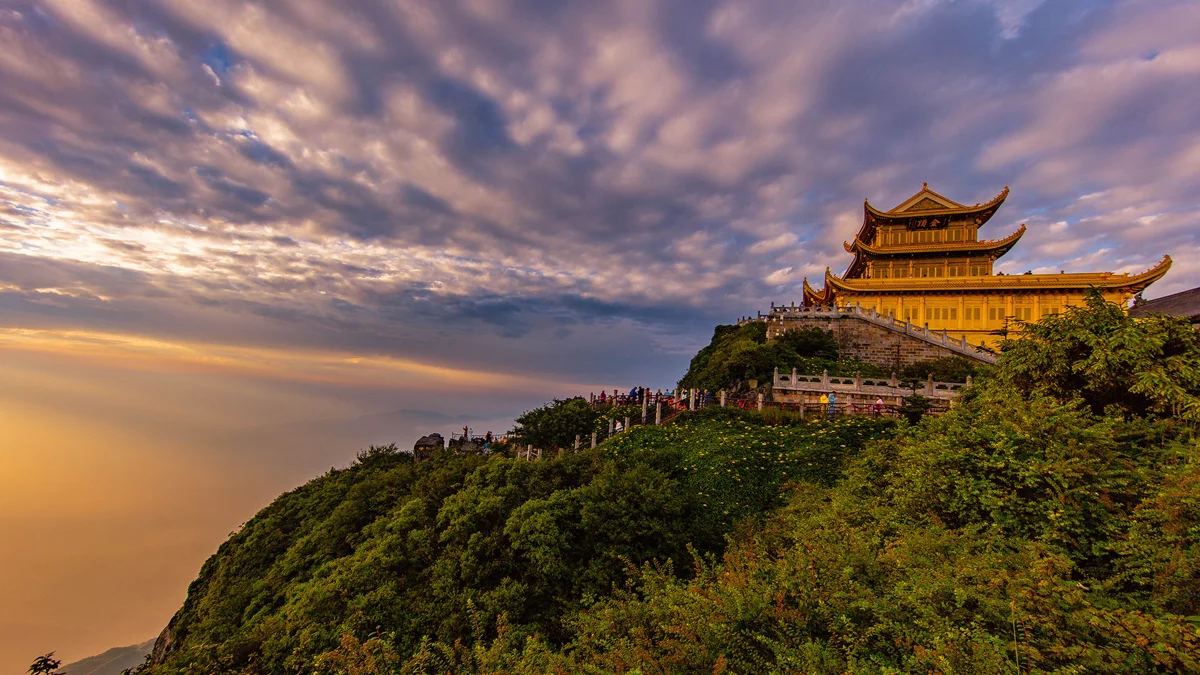
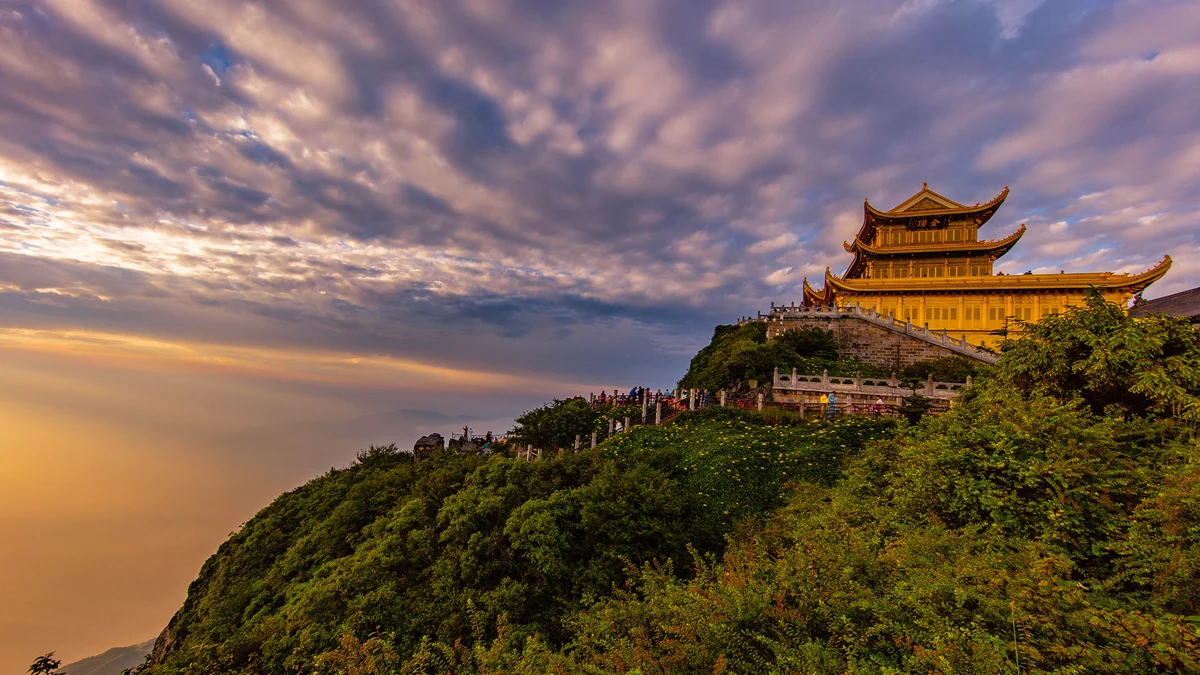
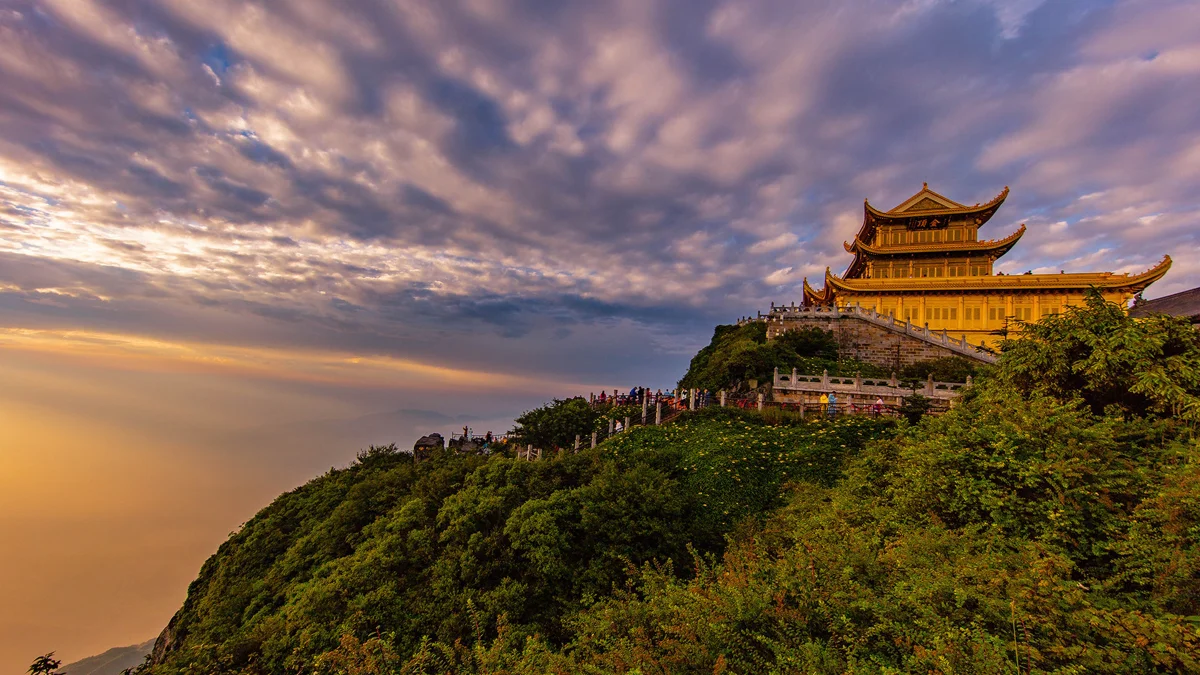
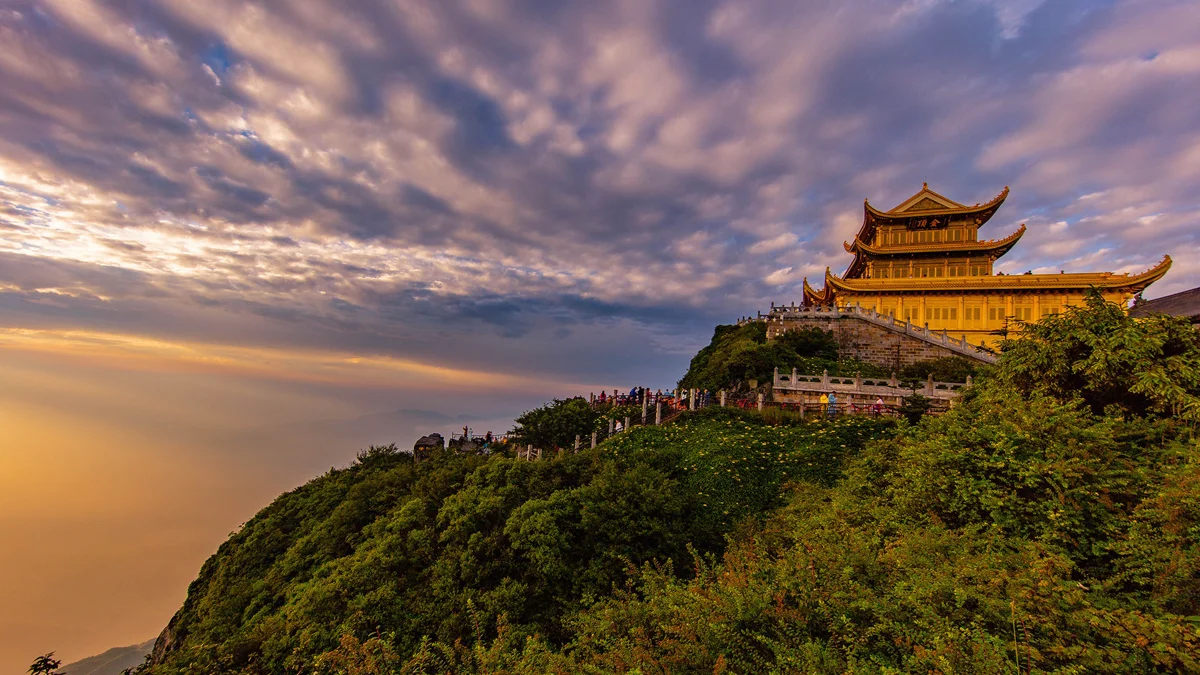
The Jinding (金顶), or Golden Summit, sits at 3,077 meters and represents the spiritual apex of Mount Emei. Here, perched on a cliff edge that drops into an abyss of cloud, stands the Huazang Temple (华藏寺) — rebuilt in the 1980s on foundations that date to the Ming Dynasty. The temple’s golden roofs catch the light in ways that gave the summit its name, glowing against the deep blue of the Sichuan sky like a beacon visible from the valley floor, 2,600 meters below.
But the true centerpiece of the Golden Summit is the 48-meter-tall gilded statue of Samantabhadra riding a six-tusked white elephant — the largest of its kind in the world. The ten-headed, thirty-six-armed bodhisattva, cast in bronze and covered in gold leaf, was completed in 2006 after three years of construction. It stands facing east, as if gazing out over the empire that has venerated it for millennia. On clear days, the statue catches the first rays of sunrise, and pilgrims who have hiked through the night to be present describe the moment as transformative — the gold catching fire against a sky streaked with rose and amber.
Historical Note: The first Buddhist temple on Mount Emei was built during the Eastern Han Dynasty (25–220 CE), making it one of the earliest sites of Buddhist worship in China. By the Tang Dynasty, Emeishan had become a major pilgrimage destination, with emperors commissioning temples and monasteries along the ascent. The mountain’s association with Samantabhadra dates to the Song Dynasty, when the bodhisattva was formally enshrined as the mountain’s patron deity.
◆
Sunrise and the Sea of Clouds: Nature’s Cathedral
Perhaps no single experience defines Mount Emei quite like witnessing sunrise from the Golden Summit. Between 6:30 and 7:00 AM, when conditions align, the eastern horizon ignites in bands of gold and crimson. Below, a vast sea of clouds (云海) stretches to the horizon, its surface undulating like a slow-motion ocean. Peaks emerge from the cloud layer as islands in an ethereal sea, and the golden Samantabhadra statue glows against the rising sun in a spectacle that photographers and pilgrims alike describe as otherworldly.
The most celebrated phenomenon, however, is the Buddha’s Halo (佛光) — a rare optical effect in which a circular rainbow appears around the observer’s shadow, projected onto the cloud surface below. The phenomenon occurs most frequently between April and September, typically in the early morning after rain, when sunlight refracts through moisture droplets in the air. Historical records from the Tang Dynasty describe court officials who traveled to Emeishan specifically to witness this “miracle of the dharma circle.” Modern science identifies it as a glory — the same optical principle that creates halos around aircraft shadows on clouds — but standing on the cliff edge at 3,077 meters, watching a perfect rainbow encircle your own silhouette against the clouds below, the distinction between physics and spirituality feels irrelevant.
When to Go: Sunrise viewing is best from October through March, when skies are clearest. Summer brings dramatic cloud formations but also morning fog that can obscure the view. Arrive at the summit by 6:00 AM to secure a good position at the viewing platform east of the Samantabhadra statue. On peak weekends, hundreds gather before dawn.
The Pilgrim’s Path: A Trail Through Centuries
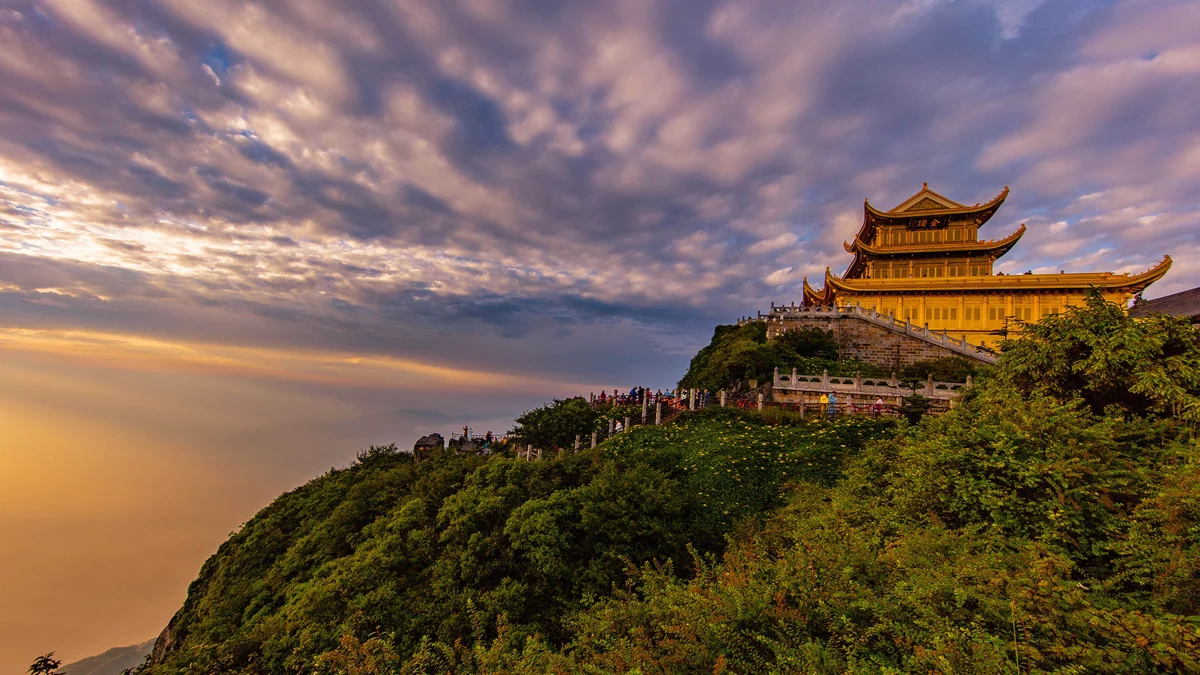
Mount Emei’s traditional hiking route spans approximately 50 kilometers from the base at Baoguo Temple to the Golden Summit, ascending through a vertical cross-section of ecosystems that would normally require traveling from subtropical to alpine zones. The trail is not a single continuous climb but a series of stages, each with its own character, temples, and rhythms.
Baoguo Temple — The Gateway
The journey begins at Baoguo Temple (报国寺), a Ming Dynasty complex that serves as the administrative and spiritual entrance to the mountain. Founded in 1615 and rebuilt multiple times, the temple is known for its three Buddha halls arranged along a central axis, its ancient camphor trees, and a bronze bell cast during the reign of the Kangxi Emperor. Pilgrims traditionally stop here to burn incense and offer prayers before beginning the ascent. The temple grounds are peaceful and uncrowded compared to the upper mountain, offering a contemplative counterpoint to the dramatic vistas above.
Qingyin Pavilion — Where Waters Meet
The trail from Baoguo leads to Qingyin Pavilion (清音阁), a double-pavilion structure perched above the confluence of the Black Dragon and White Dragon rivers. The rushing water carves through a gorge of smooth stone, and the sound — a constant roar amplified by the surrounding cliffs — gives the pavilion its name: “Pavilion of Clear Sound.” This is the ecological heart of the lower mountain, where subtropical broadleaf forest gives way to mixed woodland, and the air is thick with moisture and birdsong.
Wannian Temple — The Iron Buddha
Further up the trail, Wannian Temple (万年寺) houses one of Emeishan’s most remarkable artifacts: a bronze statue of Samantabhadra cast in 980 CE during the Northern Song Dynasty, weighing an estimated 62 tons. The statue depicts the bodhisattva seated cross-legged on a lotus base, supported by four elephants, and it has survived earthquakes, wars, and the Cultural Revolution. The temple itself is architecturally unusual — its main hall is a brick vault built without a single wooden beam, a design imported from India during the Tang Dynasty that earned it the nickname “the unrotting hall.”
The Final Ascent
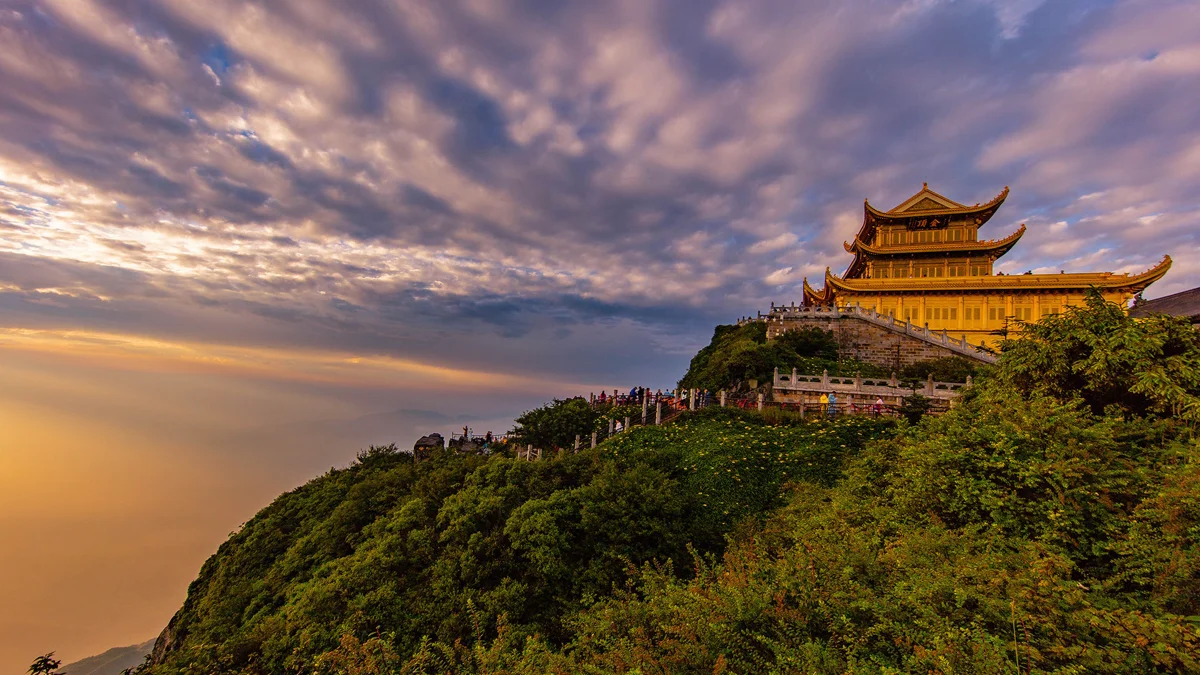
From Wannian Temple, the trail steepens dramatically. The final 12 kilometers to the Golden Summit pass through increasingly sparse vegetation — deciduous giving way to coniferous, then to exposed rock and alpine meadow. In winter, the trail is often blanketed in snow and ice, requiring crampons and poles. In summer, the ascent is shaded by ancient fir trees draped in moss and lichen, with waterfalls visible from the trail. The last two kilometers are the most demanding: a relentless climb on stone steps that have been worn smooth by centuries of pilgrim feet.
◆
Wild Monkeys: The Mountain’s Other Inhabitants
No account of Mount Emei is complete without mentioning its most famous — and most feared — residents. An estimated 1,000+ Tibetan macaques (藏酋猴) inhabit the mountain’s middle elevations, primarily between Qingyin Pavilion and Wannian Temple. These are not the polite, keep-to-themselves primates of some nature documentaries. Emeishan’s monkeys are bold, strategic, and have learned over decades of tourist interaction that human hands contain food.
They will approach. They will sit on the trail ahead of you. They will study your pockets, your backpack, and your facial expressions with unsettling intelligence. And if you are carrying a plastic bag — any plastic bag, whether containing food or not — they will likely attempt to take it.
Critical Advice: Do not carry visible plastic bags on the trail. Do not make eye contact with the monkeys. Do not feed them. Do not attempt to touch or photograph them at close range. Keep food sealed inside your backpack, not in outer pockets. If a monkey blocks your path, stop, avoid eye contact, and wait — they will typically lose interest and move on. Do not run, as this triggers chase behavior.
The monkeys are protected as part of Emeishan’s ecosystem, and aggressive deterrents are used sparingly. Rangers patrol the main trail sections and can assist if an encounter escalates. Most visitors find the monkeys amusing from a distance — and genuinely alarming up close. The experience, however, is an integral part of the mountain’s living ecology.
Mist, Memory, and the Mountain’s Mood
Mount Emei is a mountain of weather. Fog rolls through its valleys with startling speed, transforming a clear morning into a world of muted grays and ghostly silhouettes within minutes. Rain is frequent — the mountain receives over 1,900 millimeters annually — and the resulting moisture sustains one of the most biodiverse forests in western China. Ancient trees draped in hanging moss, rhododendron thickets that bloom in explosive color from April through June, and rare orchids hidden in the understory all owe their existence to this perpetual dampness.
For the pilgrim, the mist is not an inconvenience but a companion. Buddhist scripture describes Samantabhadra’s realm as a place beyond form, where reality dissolves into pure consciousness. Walking through Emei’s fog, with the trail vanishing five meters ahead and the world reduced to the sound of your own footsteps and the drip of water from stone, the metaphor becomes experiential. The mountain does not reveal itself all at once. It offers glimpses — a temple bell, a golden roof, the flash of a monkey’s face — and then withdraws behind its curtain of cloud.
What the Mist Teaches: Emeishan’s weather patterns are part of its spiritual architecture. The mountain is most beautiful not on clear days, but in the liminal moments when fog parts briefly to reveal a cliff face, a waterfall, or a distant peak — then closes again. Patience is the mountain’s lesson.
The Summit in Snow: Winter on Emeishan
Mount Emei in winter is a different world. From December through February, the Golden Summit is frequently blanketed in snow, and the Samantabhadra statue rises from a white landscape like a figure from a Buddhist painting. The sea of clouds is less reliable in winter, but when it appears, the contrast between white snow and golden cloud creates a visual spectacle that summer cannot match.
Temperatures at the summit drop well below freezing, and ice can make the trail treacherous. The cable car, however, operates year-round (conditions permitting), making winter summit visits accessible even to those unwilling to hike through snow. For photographers, winter offers the clearest skies and the most dramatic light — low-angle sun that paints the snow in shades of gold and lavender during the hours around sunrise.
◆
Practical Information
Getting There
From Chengdu: The Chengdu–Emeishan High-Speed Railway (成绵乐城际铁路) connects Chengdu South Station to Emeishan Station in approximately one hour. Trains depart every 20–30 minutes from 7:00 AM to 9:00 PM. Tickets cost ¥50–65 (~$7–$9) depending on seat class. From Emeishan Station, public bus Route 8 connects to the Baoguo Temple entrance in 20 minutes (¥2 / ~$0.30).
By Air: The nearest airport is Chengdu Tianfu International Airport (TFU), approximately 150 km from Emeishan. Airport buses and high-speed rail connections make the transfer straightforward.
By Car: The G5 Beijing–Kunming Expressway and local roads provide access, but parking at the scenic area is limited during peak seasons.
Opening Hours
The Mount Emei Scenic Area operates daily from 6:00 AM to 6:00 PM. The cable car to the Golden Summit typically operates from 7:00 AM to 5:30 PM (extended during peak seasons). Early morning access is available for hikers on the traditional trail — you can begin ascending before dawn.
Tickets and Fees
| Item | Price | Approx. USD |
|---|---|---|
| Scenic Area Entrance (peak season: Jan 16–Dec 14) | ¥160 | ~$22 |
| Scenic Area Entrance (off-peak: Dec 15–Jan 15) | ¥110 | ~$15 |
| Cable Car — Up (Jinding Station) | ¥55 | ~$7.50 |
| Cable Car — Down (Jinding Station) | ¥55 | ~$7.50 |
| Shuttle Bus (Baoguo to Lei Dong Ping) | ¥90 | ~$12 |
| Emeishan Museum (at Golden Summit) | Free | Free |
Note: The entrance fee is valid for one day. If staying overnight on the mountain, a second-day entry requires purchasing a supplementary ticket (¥80 / ~$11). Most hikers purchase the round-trip cable car ticket at the base station to save the queue at the summit.
Best Time to Visit
| Season | Conditions | Recommendation |
|---|---|---|
| Spring (Apr–May) | Rhododendrons blooming, moderate temperatures, occasional rain | ★★★★ Excellent |
| Summer (Jun–Aug) | Hot and humid at base, pleasant at summit, frequent rain and fog, monkeys active | ★★★ Good (expect rain) |
| Autumn (Sep–Oct) | Clear skies, golden foliage, best sunrise visibility | ★★★★★ Best |
| Winter (Dec–Feb) | Snow and ice at summit, fewer crowds, dramatic photography, cable car operational | ★★★★ Excellent (with proper gear) |
Avoid: Chinese national holidays (Golden Week in early October, Chinese New Year in January/February) when the mountain is extremely crowded and accommodation prices triple.
Recommended Itinerary: 2 Days
Day 1: Base to Mountain
| Time | Activity |
|---|---|
| 08:00 | Arrive at Baoguo Temple, purchase entrance ticket |
| 08:30 | Visit Baoguo Temple grounds |
| 09:30 | Take shuttle bus to Lei Dong Ping (or begin hiking) |
| 11:00 | Arrive at Qingyin Pavilion, explore the gorge |
| 12:30 | Lunch at a trailside restaurant |
| 14:00 | Continue hike to Wannian Temple (or take cable car) |
| 16:00 | Check in at mountain hotel (near Wannian Temple or Jieyin Ding) |
| Evening | Rest, prepare for early morning |
Day 2: Summit and Sunrise
| Time | Activity |
|---|---|
| 05:00 | Wake up, begin hike or cable car to Golden Summit |
| 06:00 | Arrive at Golden Summit, secure viewing position |
| 06:30–07:00 | Sunrise and sea of clouds viewing |
| 07:30 | Explore Huazang Temple, photograph the Samantabhadra statue |
| 09:00 | Visit Emeishan Museum |
| 10:00 | Begin descent (cable car or hike) |
| 13:00 | Arrive at base, depart for Emeishan Station |
Where to Stay
Mountain-top hotels near the Golden Summit offer basic accommodation with extraordinary views. The most popular option is the Emeishan Hotel (金顶大酒店) at the summit itself, where rooms facing east provide direct sunrise views from your window. Book well in advance during peak season.
For budget travelers, guesthouses along the trail between Qingyin Pavilion and Wannian Temple offer simple rooms (¥100–200 / ~$14–$28) with shared facilities. The experience of sleeping on the mountain, waking to the sound of temple bells, and stepping out into misty dawn is worth the modest discomfort.
◆
Budget Estimate: Solo Traveler (2 Days)
| Category | Cost (¥) | Cost (USD) | Notes |
|---|---|---|---|
| Train (Chengdu round trip) | 100–130 | $14–$18 | High-speed rail |
| Entrance Fee (2 days) | 240 | $33 | ¥160 + ¥80 second-day supplement |
| Cable Car (round trip) | 110 | $15 | Optional but recommended |
| Shuttle Bus | 90 | $12 | Base to Lei Dong Ping |
| Mountain Hotel (1 night) | 300–600 | $42–$83 | Budget to mid-range |
| Meals (2 days) | 150–250 | $21–$35 | Mountain restaurants pricier than base |
| Miscellaneous | 50–100 | $7–$14 | Water, snacks, incense |
| Total | ¥1,040–1,520 | ~$144–$210 |
Budget Tip: Hiking the full trail instead of taking the cable car saves ¥110 but adds 4–6 hours of strenuous uphill walking. The shuttle bus (¥90) can be skipped by hiking from Baoguo Temple to Lei Dong Ping — a 3-hour ascent through beautiful forest.
Frequently Asked Questions
Can you climb Mount Emei in one day?
Technically yes, but it requires an extremely early start and excellent fitness. The full hiking route from Baoguo Temple to the Golden Summit takes 8–12 hours one way. Most visitors take the cable car for at least one direction. A realistic one-day plan: take the bus to Lei Dong Ping (7:00 AM), ride the cable car to the summit (7:30 AM), spend two hours exploring, then ride down and return to Chengdu by evening. You will miss the lower temples and the monkeys.
Are the monkeys dangerous?
The Tibetan macaques on Mount Emei are not aggressive in the way a predator is aggressive, but they are bold, strong, and unpredictable. Bites are rare but do occur — the scenic area reports approximately 20–30 incidents per year among millions of visitors. The key precautions are simple: do not carry visible food or plastic bags, do not feed them, do not make sudden movements or direct eye contact, and do not attempt to touch them. Rangers patrol the main trail sections. Incidents are almost exclusively the result of tourists ignoring these guidelines.
What should I pack?
For a two-day visit, essential items include:
- Layers: Temperature drops approximately 6°C for every 1,000 meters of elevation. The summit can be 15–20°C colder than the base.
- Rain gear: A lightweight waterproof jacket is essential year-round. Disposable rain ponchos are available at the base but overpriced.
- Sturdy footwear: The stone steps are worn smooth and become slippery when wet. Hiking boots with good grip are strongly recommended.
- Headlamp/flashlight: For pre-dawn sunrise hikes and dimly lit temple interiors.
- Water and snacks: Available on the mountain but at 2–3× base prices.
- Small backpack: Large enough for layers and snacks, small enough to manage on narrow trails. Avoid plastic bags.
- Cash: Some mountain vendors and temples do not accept mobile payment.
A Note on Sacred Space
Mount Emei is not merely a scenic destination — it is an active religious site. Temples along the trail are places of worship, and monks and pilgrims treat them with reverence. Visitors are welcome, but courtesy is expected: remove hats inside temple halls, do not photograph altars without permission, and speak softly in prayer areas. The incense sold at temples (¥10–30 / ~$1.50–$4) can be offered at designated burners — this is not a commercial transaction but a spiritual practice, and understanding its significance enriches the experience immeasurably.
The mountain has endured — through dynasties, revolutions, and the relentless pressure of modern tourism — because people believe in it. Whether you come as a pilgrim, a photographer, a hiker, or simply a curious traveler, Emeishan offers something rare: a landscape where nature and devotion are so thoroughly intertwined that separating them becomes impossible. The clouds do not merely surround the mountain. They are part of its meaning.
Final Thought: The Buddhist concept of pūjā — reverence through action — finds its most physical expression on Mount Emei. The act of climbing, of placing one foot before the other on stone steps worn by a million pilgrims before you, is itself a form of prayer. You do not need to be Buddhist to feel it. You only need to walk.