Dunhuang Deep Dive: Silk Road’s Greatest Treasure
📅 Best visited April–October | 📍 Gansu Province, Northwest China | ⏱️ Recommended 3–4 days
Table of Contents
- Why Dunhuang? — The Silk Road’s Soul
- When Should I Go? — Weather & Seasons
- How Many Days Do I Need? — Quick Answer
- How Do I Get There? — Flights & Trains
- What Must I See? — The Big Five
- 🧳 Mogao Caves — The Main Event (Booking Required!)
- 🏜️ Mingsha Mountain & Crescent Moon Spring
- 📌 Yumen Pass & Hecang City — Echoes of the Han Dynasty
- 🎯 Desert Adventures — Beyond the Sights
- 🍜 What to Eat — Dunhuang’s Table
- 💸 Budget Breakdown — How Much Will It Cost?
- ❓ FAQ — Your Questions Answered
🎯 Why Dunhuang? — The Silk Road’s Soul
I remember the first time I saw Dunhuang from the window of a rattling train car. The Gobi Desert stretched out in every direction — a grey-brown nothingness that seemed to go on forever. Then, suddenly, an oasis appeared: a cluster of green trees, whitewashed buildings, and the unmistakable silhouette of a giant Buddha carved into a cliff face. This was it. The place where, for over a thousand years, East met West.
Dunhuang was once the gateway to China on the legendary Silk Road. Caravans carrying silk, spices, jade, and ideas would stop here to rest, trade, and pray. Buddhism entered China through this very corridor, carried by monks traveling from India and Central Asia. The Mogao Caves — a complex of 492 Buddhist cave temples filled with murals and statues — are the physical testament to that extraordinary cultural fusion.
Today, Dunhuang is a UNESCO World Heritage site and one of China’s most remarkable destinations. It’s remote — a four-hour flight from Beijing or Shanghai — but that remoteness only adds to the magic. You don’t stumble into Dunhuang. You arrive with purpose.
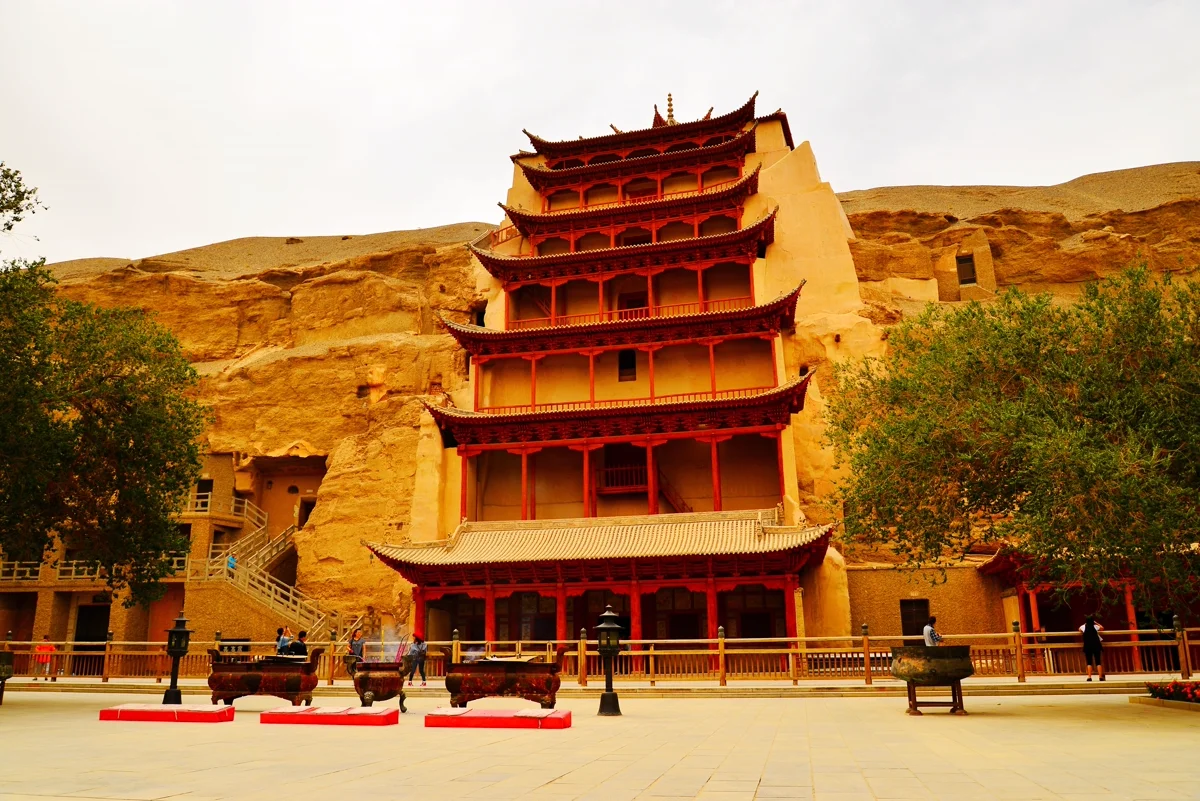
The cliff face of the Mogao Caves — centuries of Buddhist art carved into the desert
☀️ When Should I Go? — Weather & Seasons
Is it too hot?
Yes, it gets brutally hot. But only in summer.
| Season | Temperature | Crowds | Verdict |
|---|---|---|---|
| Spring (Mar–May) | 10–25°C / 50–77°F | Light | 🌸 Pleasant but occasional sandstorms |
| Summer (Jun–Aug) | 30–40°C / 86–104°F | Heavy | ☀️ Peak season, book everything early |
| Autumn (Sep–Oct) | 15–28°C / 59–82°F | Moderate | 🏆 Best season — golden light, cool air |
| Winter (Nov–Feb) | −5–8°C / 23–46°F | Very light | ❄️ Empty sights but bitter cold |
My advice? Go in late September or early October. The summer heat has broken, the sky is that impossible northwestern blue, and the autumn light hitting the sand dunes is something you’ll remember for a lifetime. I went in mid-October and had the Yumen Pass nearly to myself.
If you must go in summer, bring a wide-brimmed hat, sunscreen SPF 50+, and at least one liter of water per hour of outdoor activity. The desert does not mess around.
⏱️ How Many Days Do I Need? — Quick Answer
3 full days is the sweet spot. Here’s the breakdown:
| Day | Focus | Highlights |
|---|---|---|
| Day 1 | Mogao Caves + Museum | The caves (half day), Dunhuang Museum (afternoon) |
| Day 2 | Mingsha Mountain + Crescent Lake | Sand sliding, camel rides, sunset hike |
| Day 3 | Western Han Dynasty Ruins | Yumen Pass, Hecang City, Great Wall (full-day trip) |
If you only have 2 days, skip the Western Han ruins. If you have 4, add a desert camping night.
✈️ How Do I Get There? — Flights & Trains
Flying (Best Option)
Dunhuang’s airport (DNH) receives direct flights from:
- Beijing — 3.5 hours
- Shanghai — 4 hours (with a stop in Xi’an)
- Xi’an — 1.5 hours (most convenient connection)
- Lanzhou — 1.5 hours
- Urumqi — 2 hours
By Train
Dunhuang Railway Station connects to the high-speed network via Lanzhou:
- Lanzhou → Dunhuang: 5–8 hours (bullet train, ¥250 / ~$35)
- Xi’an → Dunhuang: 10–12 hours (overnight sleeper, ¥350 / ~$48)
The overnight sleeper from Xi’an is actually one of my favorite travel experiences in China. You fall asleep in the ancient capital, then wake up in the desert — and the sunrise over the loess plateau is spectacular.
🏆 What Must I See? — The Big Five
Let me be honest: Dunhuang is not a city of endless attractions. What it offers is depth over breadth. These five sights are the reason you come here, and each deserves real time.
🧳 Mogao Caves — The Main Event (Booking Required!)
⚠️ Booking is mandatory. You cannot just show up. During peak season (May–October), tickets sell out days, sometimes weeks in advance. Book through the official WeChat mini-program or your hotel concierge.
| Detail | Info |
|---|---|
| Ticket Price | ¥238 / ~$33 (standard tour, 8 caves) |
| Peak Season | ¥100 / ~$14 (student discount) |
| Opening Hours | 8:30–18:00 (summer), 9:00–17:30 (winter) |
| Guided Tours | Mandatory — included in ticket |
| Photography | ❌ No photos inside the caves |
| Booking Window | Up to 30 days in advance |
| Website | www.mogaoku.com (Chinese only, recommend hotel help) |
I can still close my eyes and see the inside of Cave 45. A serene, seated Buddha from the High Tang Dynasty (618–907 AD), his expression at once compassionate and otherworldly. The walls around him are covered in murals depicting the Western Paradise — flying apsaras (celestial beings), musicians playing pipas, and lotus blossoms floating in jewel-toned ponds. These paintings have survived for over 1,300 years because Dunhuang’s bone-dry climate preserved them like a time capsule.
The standard tour takes you through 8 caves, which sounds like a lot — but it’s barely a glimpse. The Mogao complex spans 492 caves. You’ll visit Caves 16, 17 (the Library Cave where thousands of ancient manuscripts were discovered), 96 (home to the 35-meter-tall Maitreya Buddha), and several others selected by your guide. Each cave is locked behind a steel door, and your guide unlocks them one by one.
The Library Cave (Cave 17) deserves special mention. In 1900, a Daoist priest named Wang Yuanlu stumbled upon a hidden chamber containing over 50,000 manuscripts, textiles, and paintings — a treasure trove spanning the 5th to 11th centuries. It was one of the most important archaeological discoveries of the 20th century. Most of those treasures scattered to museums in London, Paris, St. Petersburg, and Tokyo. Only a fraction remains in Dunhuang today. Standing there, inside the room where it all happened, I felt the weight of history — and of loss.
Pro tip: Arrive at 8:00 AM, before the first tour group. The morning light hitting the cliff face is beautiful, and you’ll have the site to yourself for about 30 magical minutes.
🏜️ Mingsha Mountain & Crescent Moon Spring
A camel caravan ascending the golden dunes of Mingsha Mountain
The Singing Sand Dunes
Mingsha Mountain translates to “Singing Sand Mountain” — and it’s not just poetic marketing. When the wind blows across the dunes at a certain angle, the sand produces a low, resonant hum that the locals say sounds like a pipa being strummed. I’ll be honest: I didn’t hear it clearly on my first visit. The wind was too strong. But on a calm evening, walking barefoot across the dunes, I caught it — a barely perceptible vibration more felt than heard. Magic.
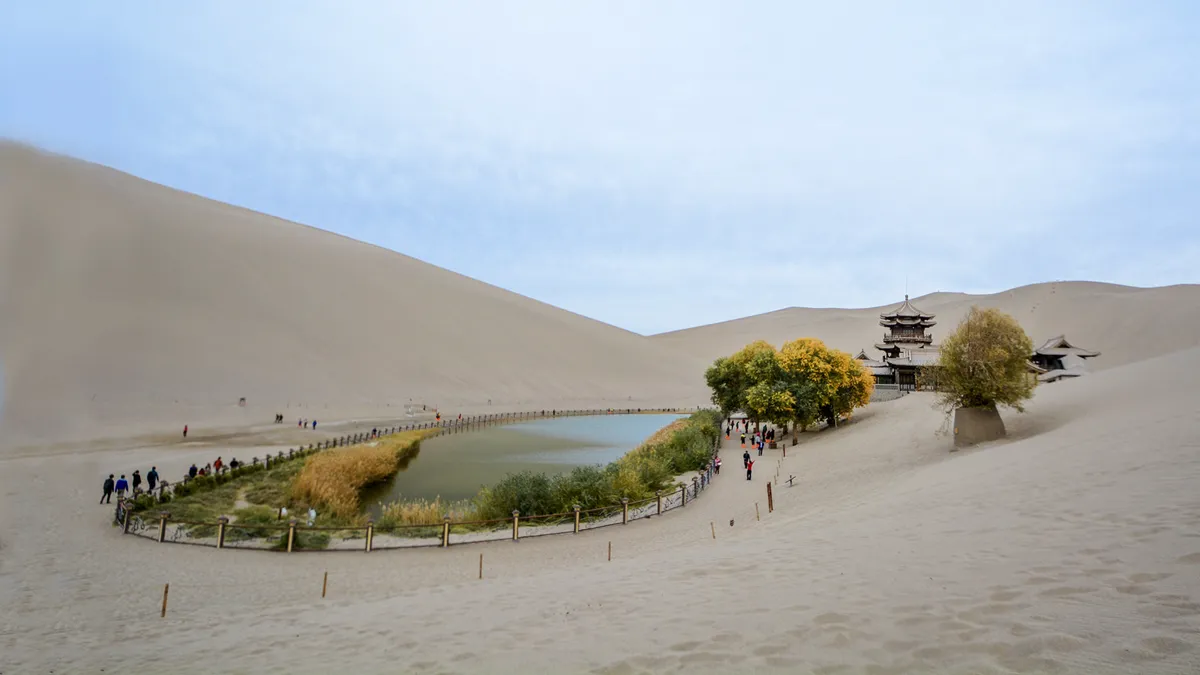
Crescent Moon Spring
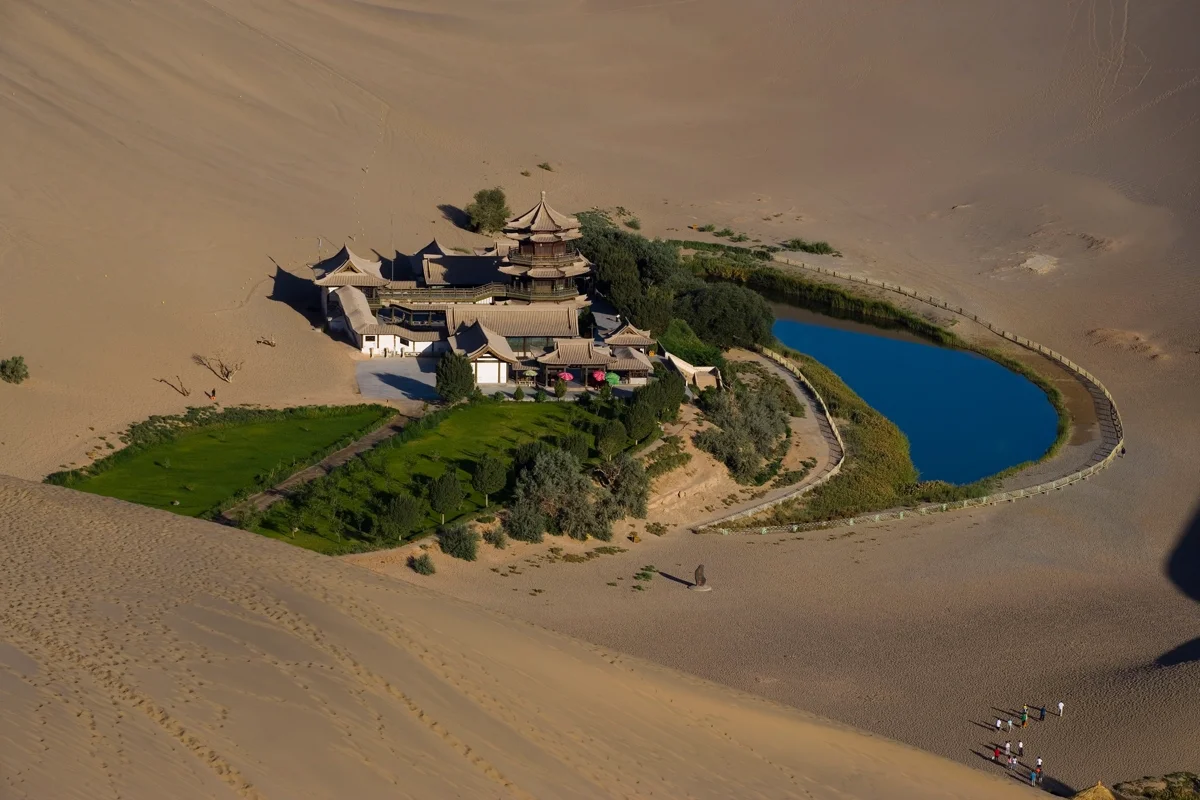
Hidden between the dunes is a crescent-shaped lake that has survived for millennia. It’s only about 100 meters long, and its water level has been dropping dangerously in recent decades. The local government has pumped water in artificially to keep it alive — controversial, maybe, but the alternative was losing one of the world’s most photogenic natural wonders.
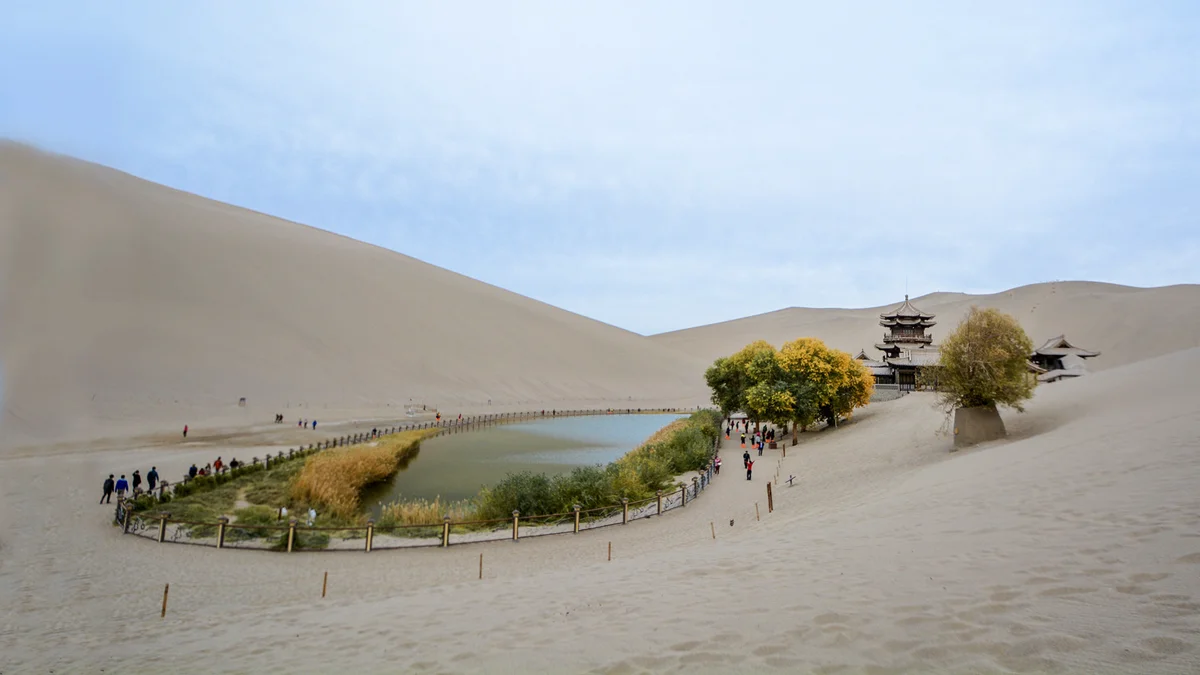
Crescent Moon Spring — an oasis that has survived centuries of desert encroachment
| Activity | Price | Time Needed |
|---|---|---|
| Camel ride | ¥100 / ~$14 | 40 minutes |
| Sand sliding | ¥30 / ~$4 | 20 minutes |
| ATV buggy | ¥150 / ~$21 | 30 minutes |
| Dune hiking | Free | 1–2 hours |
| Sunset viewing | Free (park entry ¥120 / ~$17) | From 6 PM |
Pro tip: Come at 5 PM or later. The midday heat on the dunes is ferocious, and the light is harsh for photos. Around 6:30 PM, the sand turns a deep honey-gold, and by 7 PM, the shadows stretch long and dramatic. Stay for sunset — it’s one of the best in China.
📌 Yumen Pass & Hecang City — Echoes of the Han Dynasty
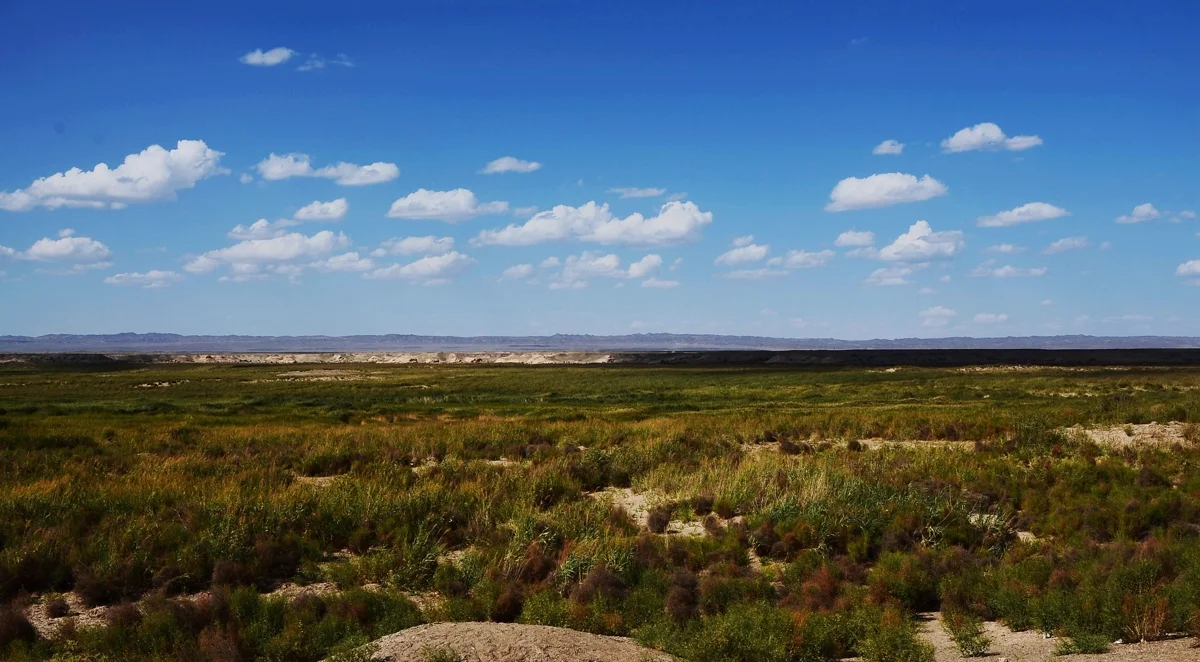
Yumen Pass — the Jade Gate where ancient caravans entered China proper
If the Mogao Caves represent Dunhuang’s spiritual heart, Yumen Pass is its military soul. This was the westernmost garrison of the Han Dynasty (206 BC – 220 AD), a fortress guarding the Silk Road against the Xiongnu nomads. The name Yumen means “Jade Gate” — because all the jade from Khotan (in present-day Xinjiang) passed through here on its way to the imperial court.
When I visited, there was nothing but wind and emptiness. The rammed-earth walls — 10 meters high in some sections — still stand, crumbling but defiant against the Gobi winds. Standing on the watchtower, you can see the remains of the Han Dynasty’s Great Wall snaking across the desert. It’s a humbling sight. These soldiers were stationed here for years at a time, thousands of kilometers from home, watching the horizon for approaching armies.
Hecang City is a 20-minute drive west of Yumen Pass — a massive rectangular granary from the Han Dynasty. It stored grain for the troops guarding the Silk Road. The scale of it — walls 300 meters long, still standing 12 meters high — is astonishing for a 2,000-year-old structure built without mortar.
| Detail | Yumen Pass | Hecang City |
|---|---|---|
| Distance from Dunhuang | 90 km west | 105 km west |
| Entry Fee | ¥90 / ~$12 (combined ticket) | Included |
| Time Needed | 45–60 minutes | 30 minutes |
| Transport | Hire a car or join a day tour (¥200–300 / ~$28–42 per person) | |
| Nearby | Han Dynasty Great Wall ruins | Desert scenery |
⚠️ Important: There is no shade, no food, and no water at these sites. Bring everything you need. The nearest shop is 30 km back toward Dunhuang.
🎯 Desert Adventures — Beyond the Sights
Desert Camping
If you really want to experience the Gobi, spend a night under the stars. Several operators run desert camping trips from Dunhuang, starting around ¥200 / ~$28 per person. The package typically includes:
- ATV riding on the dunes
- Sand sliding
- A barbecue dinner with local lamb skewers
- A bonfire with singing and dancing
- A tent overnight on the dunes
Is it comfortable? Not really. The tents are basic, there’s no shower, and the wind never quite stops. But lying on the sand at 2 AM, looking up at the Milky Way in the pitch-black desert sky — that’s a memory no luxury hotel can give you.
The Milky Way is visible from April to October, with July and August being the clearest months. Bring warm layers — the desert temperature drops dramatically at night, even in summer.
Shazhou Night Market
Back in town, head to the Shazhou Night Market for Chinese-style evening entertainment. It’s touristy, yes, but also genuinely fun. The market has over 200 stalls selling souvenirs, snacks, and local crafts. The painted clay figurines of flying apsaras make excellent gifts.
Bargaining is expected. Start at 50% of the asking price and negotiate from there. Most vendors speak enough English to handle the transaction. If you’re looking for something unique, the hand-carved wooden stamps depicting Mogao Cave motifs are beautifully crafted and lightweight for packing.
Dunhuang’s Museum — Don’t Skip It
The Dunhuang Museum (敦煌博物馆), located on Mingshan Road, is surprisingly excellent. It’s free with your ID, and it takes about 90 minutes to go through. The exhibits trace Dunhuang’s history from prehistoric times through the Silk Road heyday to the modern era. The highlight is a full-scale replica of Cave 45 — so if you want to take photos of a Mogao-style cave without breaking the no-photography rule, this is your chance. The museum also houses several original Han Dynasty artifacts excavated from nearby sites.
🍜 What to Eat — Dunhuang’s Table
Dunhuang’s cuisine is a fusion — Gansu province meets Central Asian influences, with lamb at the center of almost everything. Here’s what you must try:
| Dish | Description | Price | Where |
|---|---|---|---|
| Lanzhou Beef Noodles (兰州牛肉面) | Hand-pulled noodles in clear beef broth with chili oil | ¥15–25 / ~$2–3.50 | Any local breakfast shop |
| Lamb Stuffed Pancake (羊肉夹馍) | Crispy flatbread stuffed with cumin-spiced lamb | ¥12–18 / ~$1.70–2.50 | Shazhou Market |
| Donkey Meat Sandwich (驴肉火烧) | Yes, donkey. It’s lean, savory, and delicious | ¥15 / ~$2 | Old Horse Donkey Meat (老马驴肉) |
| Xingren Doufu (杏仁豆腐) | Almond “tofu” — a sweet, jelly-like dessert | ¥10 / ~$1.40 | Night market stalls |
| Hand-Pulled Belt Noodles | Wide, chewy noodles in a lamb broth with cumin | ¥20 / ~$3 | Noodle House on Yangguan East Road |
What I’d actually eat in a day:
- Breakfast: A massive bowl of Lanzhou beef noodles from a hole-in-the-wall shop on Mingshan Road. The owners start pulling noodles at 5 AM.
- Lunch: Lamb stuffed pancake from Shazhou Market. Cheap, filling, and absurdly good.
- Dinner: A proper lamb feast at a restaurant like Shaomai Ji (烧麦记) — cumin lamb chops, lamb soup with vermicelli, and cold cucumber salad. End with almond tofu.
A Note on Water
You’ll hear this repeatedly during your trip, but it bears repeating: drink more water than you think you need. The Gobi air is dry — humidity hovers around 30% most days. I woke up with a headache every morning until I started forcing myself to drink 3 liters a day. Carry a bottle everywhere, and buy electrolyte drinks (the local brands like Jiaduobao and Gatorade alternatives are widely available).
The donkey meat sandwich caught me off guard. I tried it out of curiosity, expecting to shrug and move on. Instead, I went back for a second one. It’s leaner than beef but somehow more savory. Don’t knock it until you’ve tried it.
Grape Season — Dunhuang’s Sweet Surprise
If you visit in August or September, you’re in for a treat. Dunhuang sits in a fertile oasis, and its grape harvest is legendary. The local variety — small, seedless, and intensely sweet — is called wubai pu tao (无核白葡萄). You’ll see farmers selling them by the kilo on street corners. A huge bag costs ¥10 / ~$1.40. They’re the perfect antidote to desert heat.
💸 Budget Breakdown — How Much Will It Cost?
Dunhuang is cheaper than Beijing or Shanghai but not as cheap as smaller Gansu towns. Here’s a realistic daily budget:
| Category | Budget | Mid-Range | Comfort |
|---|---|---|---|
| Accommodation | ¥150 / ~$21 | ¥350 / ~$49 | ¥700 / ~$97 |
| Food | ¥60 / ~$8 | ¥150 / ~$21 | ¥300 / ~$42 |
| Transport (local) | ¥50 / ~$7 | ¥100 / ~$14 | ¥200 / ~$28 |
| Entrance Fees | ¥120 / ~$17 | ¥238 / ~$33 | ¥500 / ~$69 |
| Activities | ¥50 / ~$7 | ¥150 / ~$21 | ¥300 / ~$42 |
| Total Per Day | ¥430 / ~$60 | ¥988 / ~$138 | ¥2,000 / ~$280 |
3-Day Trip Total: ¥1,300–6,000 / ~$180–830
Money-Saving Tips
- Book Mogao Caves tickets online at least one week ahead (last-minute ≠ cheaper)
- Stay at a hostel near the Dunhuang Night Market (under ¥100 / ~$14)
- Eat street food for lunch (¥30 / ~$4 can get you full)
- Skip the paid desert camping package if you’re on a budget — hiking the dunes at sunset is free
❓ FAQ — Your Questions Answered
Can I see everything in one day?
No, and don’t try. The Mogao Caves alone need a half-day. The Western Han ruins (Yumen Pass, Hecang City) require a separate full-day trip 90 km west. And the sand dunes deserve a sunset. You need at least 3 days.
Is Dunhuang safe for solo travelers?
Extremely. Dunhuang is one of the safest cities I’ve traveled in. The locals are friendly and used to tourists. The biggest risk is sunburn and dehydration — bring water everywhere.
Do I need to speak Chinese?
It helps, but it’s not essential. The Mogao Caves are fully set up for English-speaking tourists (guides, signs, audio guides). Hotels and tourist restaurants in Dunhuang city will have some English. Taxi drivers won’t — have your destinations written in Chinese.
What should I pack?
| Item | Why |
|---|---|
| Sunscreen SPF 50+ | The UV at 1,200m altitude is savage |
| Lip balm + moisturizer | The dry air will crack your lips in a day |
| Wide-brimmed hat | Essential for the dunes and Yumen Pass |
| Reusable water bottle | Stay hydrated — you need 2–3L/day |
| Warm jacket | Desert nights drop 15–20°C after sunset |
| Comfortable walking shoes | You’ll walk 10,000+ steps daily |
| Face mask / bandana | Sandstorms can blow up without warning |
Is the Mogao Caves photography ban strictly enforced?
Yes. There are guards in every cave. No phones, no cameras. Flash damages the pigments. Respect the rules — you’re standing in a thousand-year-old art gallery.
Is the water safe to drink?
The tap water in Dunhuang is heavily mineralized (it’s desert groundwater). Drink bottled water — it’s ¥2 / ~$0.30 per liter. Your stomach will thank you.
Can I visit Dunhuang in winter?
You can, but it’s cold (below freezing), and some facilities — like the desert camping — shut down from November to March. The upside: Mogao Caves are nearly empty, and the snow on the dunes is stunning.
Somewhere out in the Gobi, past the last watchtower and the crumbling remains of the Great Wall, the wind still carries the whispers of caravans from a thousand years ago. Dunhuang is not just a destination. It’s a threshold — between East and West, between past and present, between the world you know and the one you’ve only read about in history books.
Go before the crowds find it. Go before the sand shifts and swallows another secret.
It’s waiting for you.
The timeless artistry of the Mogao Caves — a window into medieval China