Dazu Rock Carvings: The Symphony of Three Faiths Carved in Stone 🪷🪨☯️
📅 Last updated July 2026 · 📍 Chongqing, China · ⏱️ Full visit: 4–6 hours
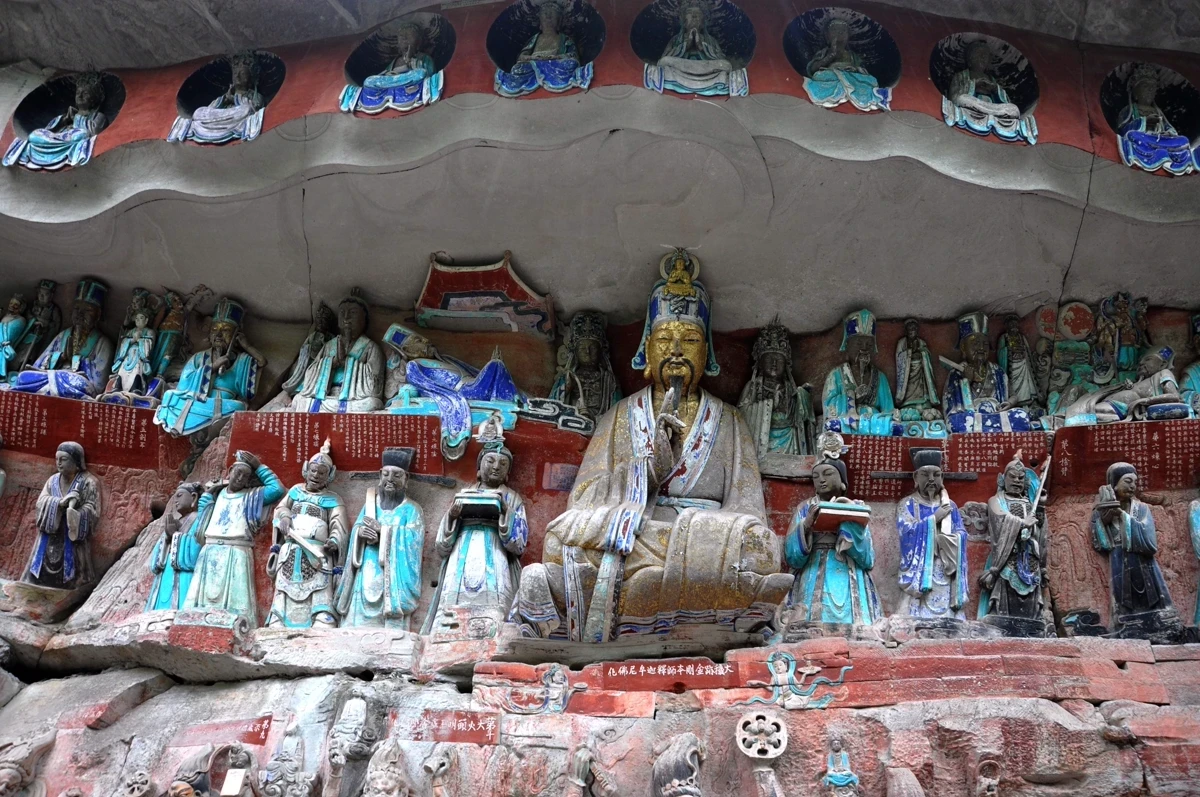
In the red sandstone hills of Dazu District, roughly 120 kilometers northwest of downtown Chongqing, some 50,000 stone sculptures whisper across a millennium of Chinese spiritual life. This is not merely a tourist attraction—it is the only major grotto site in the world where Buddhism, Taoism, and Confucianism coexist in carved stone, unified into a single sacred landscape that UNESCO inscribed in 1999 as a World Heritage Site.
The Dazu Rock Carvings span 75 protected sites across the district, but the two that matter most—Baoding Mountain and Beishan—contain the overwhelming majority of the masterworks. Together they tell the story of China’s religious imagination from the late Tang dynasty (9th century) through the Song dynasty (13th century), a period when stone carving reached heights of narrative ambition and technical virtuosity that still stagger modern eyes.
The Three Faiths in One Mountain
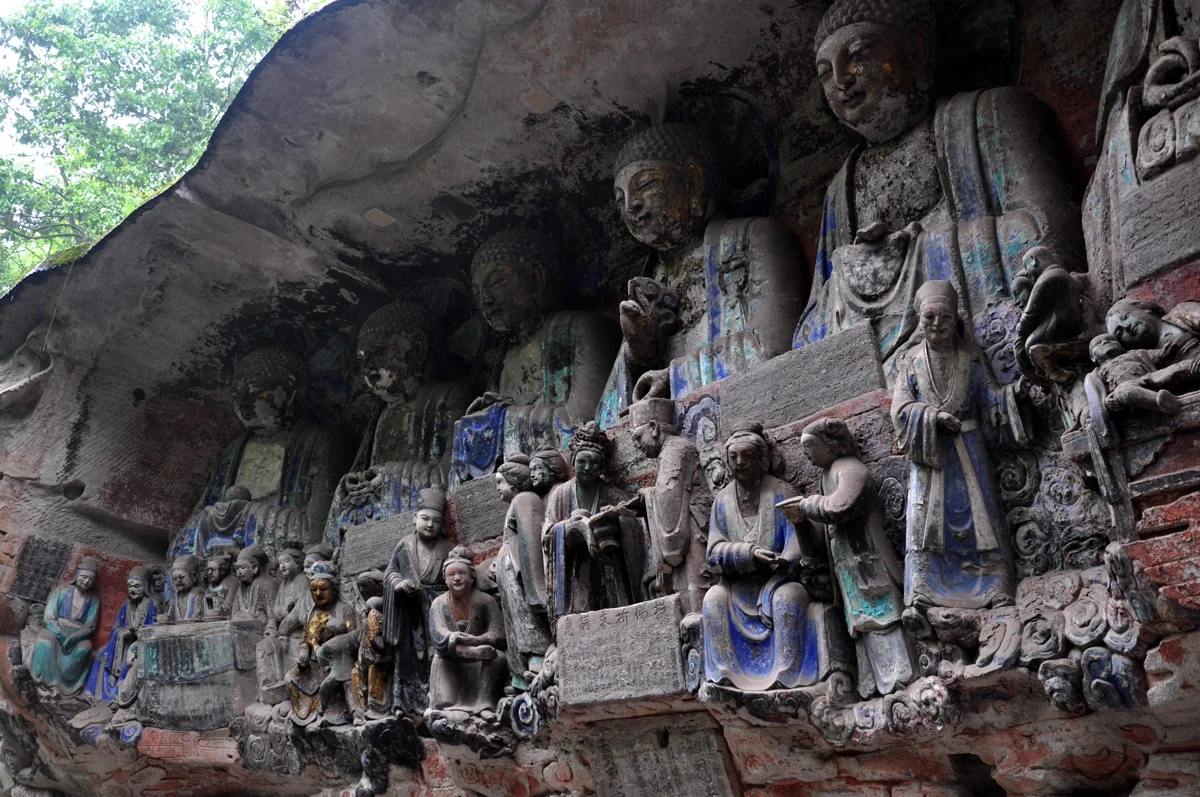
What makes Dazu unique among China’s great grottoes—Longmen, Yungang, Dunhuang, Maijishan—is its theological audacity. At most Chinese cave temple sites, you find one dominant tradition: Buddhism at Longmen, Buddhism at Yungang, a mix of Buddhist and Daoist at Maijishan but always with one tradition clearly in control. At Dazu, the three great Chinese faiths share the same mountain, the same cliff faces, sometimes the same panel.
This was not accidental eclecticism. It was a deliberate philosophical program. The monks and patrons who commissioned these carvings between the 9th and 13th centuries were responding to a specific cultural moment: the gradual Sinicization of Buddhism, its growing interplay with indigenous Taoism and the Confucian social order. At Dazu, this interplay found its most complete artistic expression.
◆ Editorial Note: The carvings at Beishan (892–1162 CE) reflect the earlier, more purely Buddhist phase, while Baoding Mountain (1174–1252 CE) represents the mature synthesis of all three traditions. If you visit only one, make it Baoding—it is where the three-faith vision reaches its fullest realization.
Baoding Mountain: The Picture Storybook in Stone
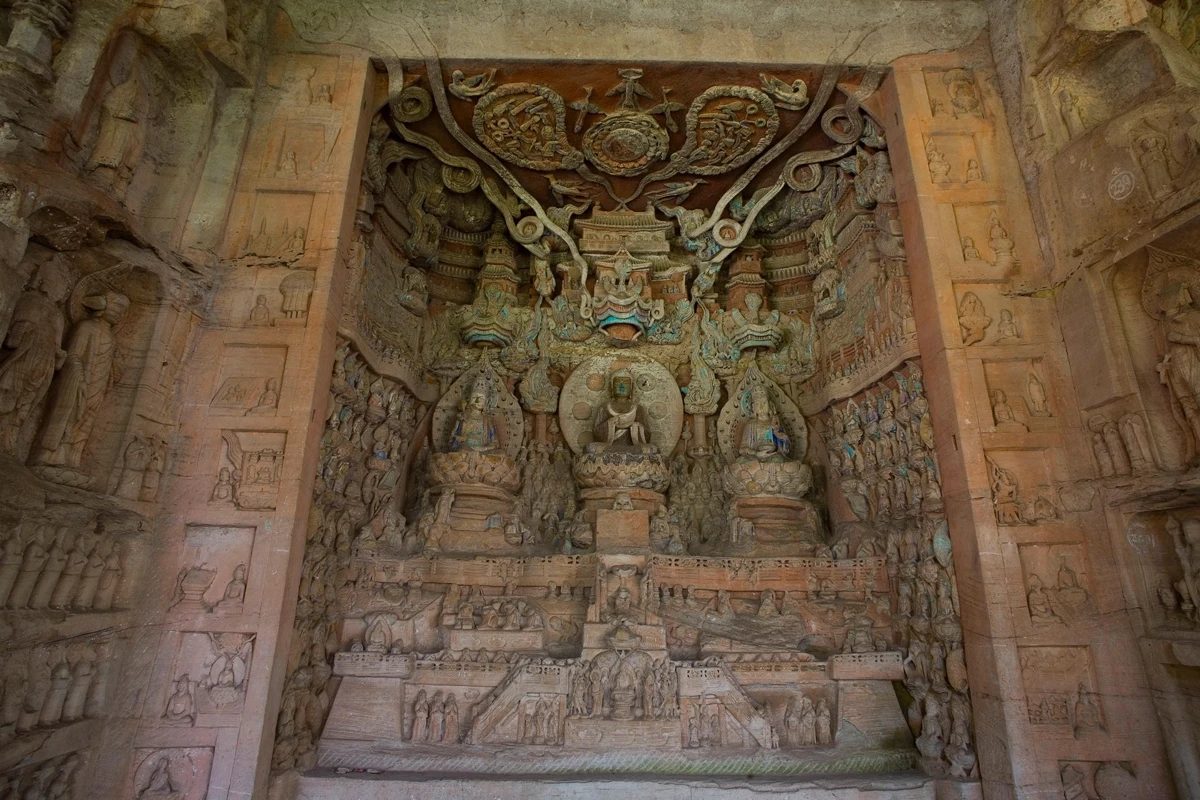
Baoding Mountain is the crown jewel of the Dazu Rock Carvings, and its creation is itself a remarkable story. In 1174 CE, a monk named Zhao Zhifeng (赵智凤) arrived at the site as a young man of just sixteen. He would spend the next seventy-five years—until his death in 1249—designing and overseeing the carving of an enormous Buddhist program directly into the mountainside.
Zhao Zhifeng’s genius was not merely artistic but pedagogical. He conceived the entire Baoding Mountain complex as a kind of “picture storybook” (经变图), a visual curriculum in stone. Each carving panel represents a specific sutra or teaching, arranged along the mountain in a deliberate sequence that guides the viewer through the progression of Buddhist understanding—from the consequences of sin to the path of enlightenment.
The result is a narrative landscape unlike anything else in the world. Where other grotto sites present individual icons in isolation, Baoding Mountain tells a continuous story across hundreds of meters of cliff face, with each scene flowing into the next. Walking through the site is less like visiting a temple and more like reading a stone epic.
The Thousand-Hand Guanyin: A National Treasure Restored
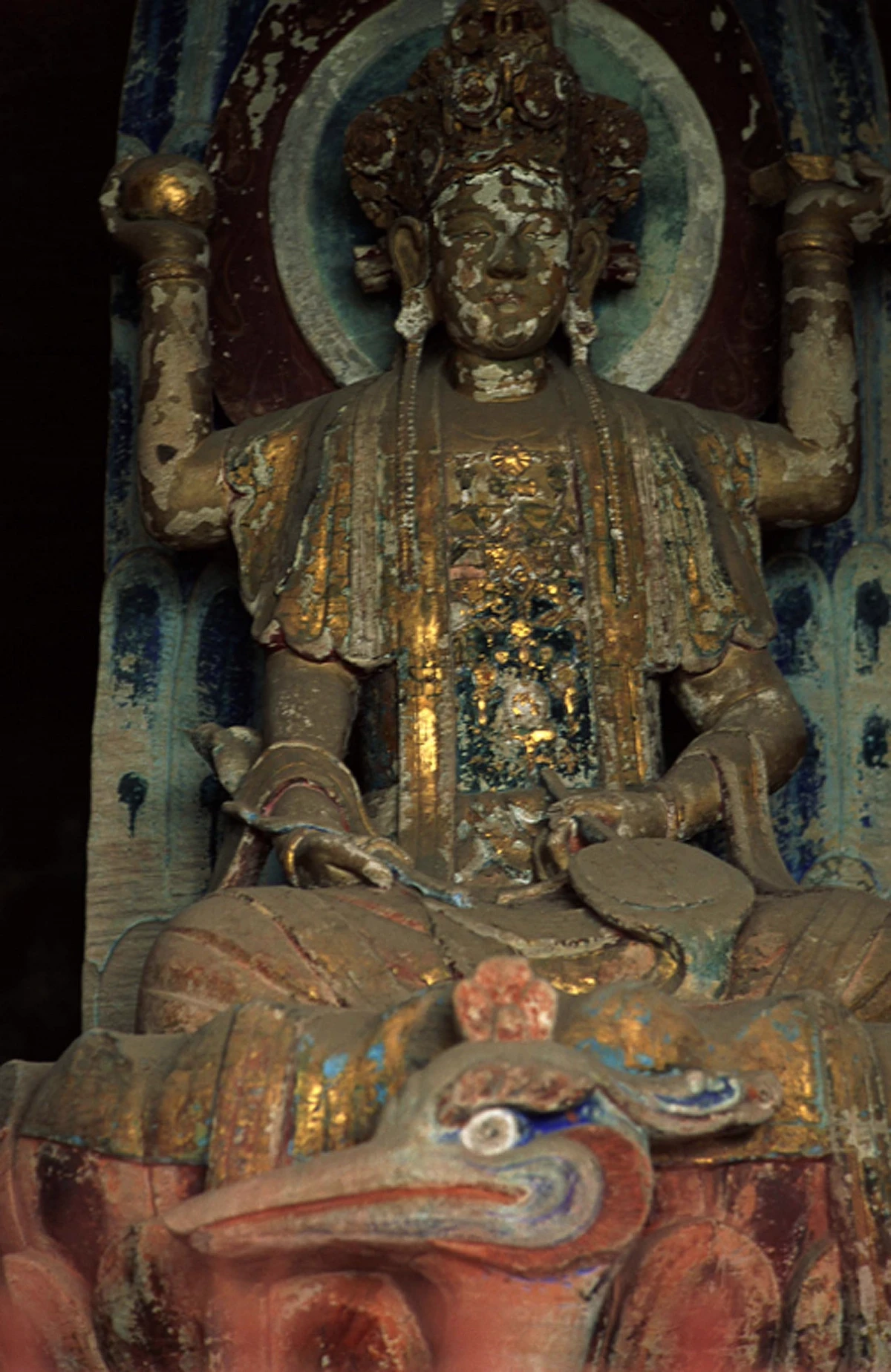
The most celebrated single carving at Dazu—and arguably one of the most important Buddhist sculptures in all of Asia—is the Thousand-Hand Guanyin (千手观音) at Baoding Mountain. This magnificent relief occupies an 88-square-meter wall surface and features an astonishing 1,007 individual hands radiating outward from the central figure of Guanyin, the Bodhisattva of Compassion.
Each hand holds a different ritual object or makes a distinct mudra, and the entire composition was originally covered in gold leaf—giving the figure its other common name, the “Golden Thousand-Hand Guanyin.” The carving dates to the Southern Song dynasty (12th–13th century) and represents one of the highest achievements of Chinese Buddhist art.
◆ Conservation Story: By the early 21st century, the Thousand-Hand Guanyin was in crisis. Centuries of water seepage, insect damage, and salt crystallization had caused over 300 of its hands to deteriorate, and the gold leaf was flaking away. In 2008, China launched a massive eight-year restoration project (completed in 2015), employing over 100 specialists in stone conservation, chemistry, and traditional gilding techniques. The restoration cost over 50 million yuan (~$7 million) and was considered one of the most complex conservation projects ever undertaken in China. Today, the figure gleams once more—a testament to both ancient artistry and modern science.
Hell, Morality, and the Wheel of Reincarnation
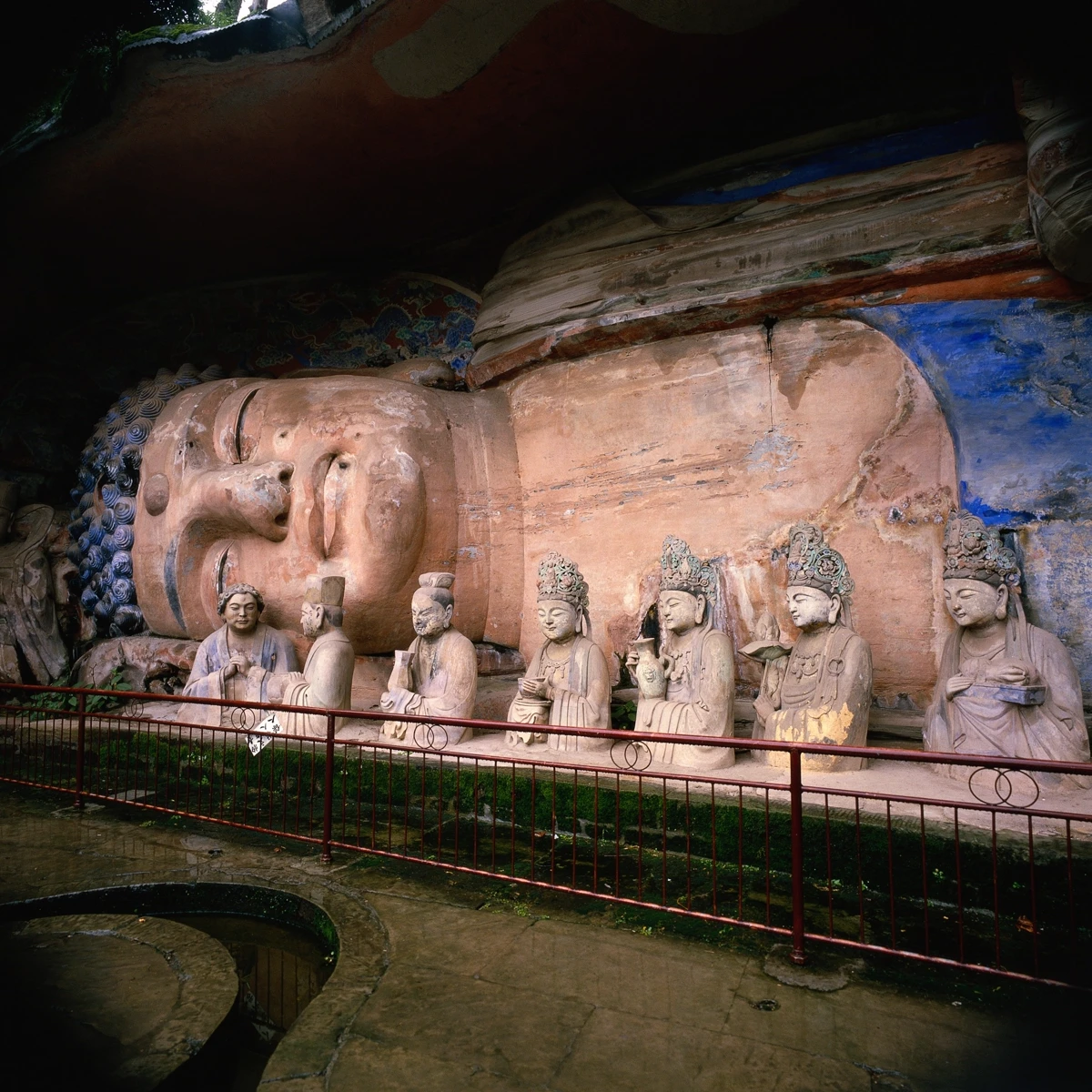
Among the most viscerally memorable carvings at Baoding Mountain are the Hell Scenes (地狱变相)—graphic depictions of the punishments awaiting sinners in the underworld. These panels show sinners subjected to boiling in oil, dismemberment, and being crushed between mountains, rendered with a startling realism that served a clear didactic purpose.
But the Hell Scenes are not gratuitous. They are part of Zhao Zhifeng’s larger moral program. Flanking the punishments are scenes of virtuous behavior—filial piety, generosity, compassion—that offer the alternative path. The Wheel of Reincarnation (六道轮回) ties it all together: a massive circular carving showing the six realms of existence through which all beings cycle, driven by their karma.
The emotional impact of these carvings is hard to overstate. Standing before the Hell Scenes, one understands immediately that Dazu was designed not merely to be admired but to be felt. Zhao Zhifeng wanted visitors to experience something close to fear—and then hope—as they moved through his stone curriculum.
Beishan: Where Tang Elegance Meets Song Precision
If Baoding Mountain is the theological tour de force of the Dazu Rock Carvings, Beishan (北山) is the artistic one. The carvings here span from 892 to 1162 CE—roughly 270 years of continuous work—and they chart the evolution of Chinese stone carving from the graceful, idealized forms of the late Tang dynasty to the detailed, narrative realism of the Song.
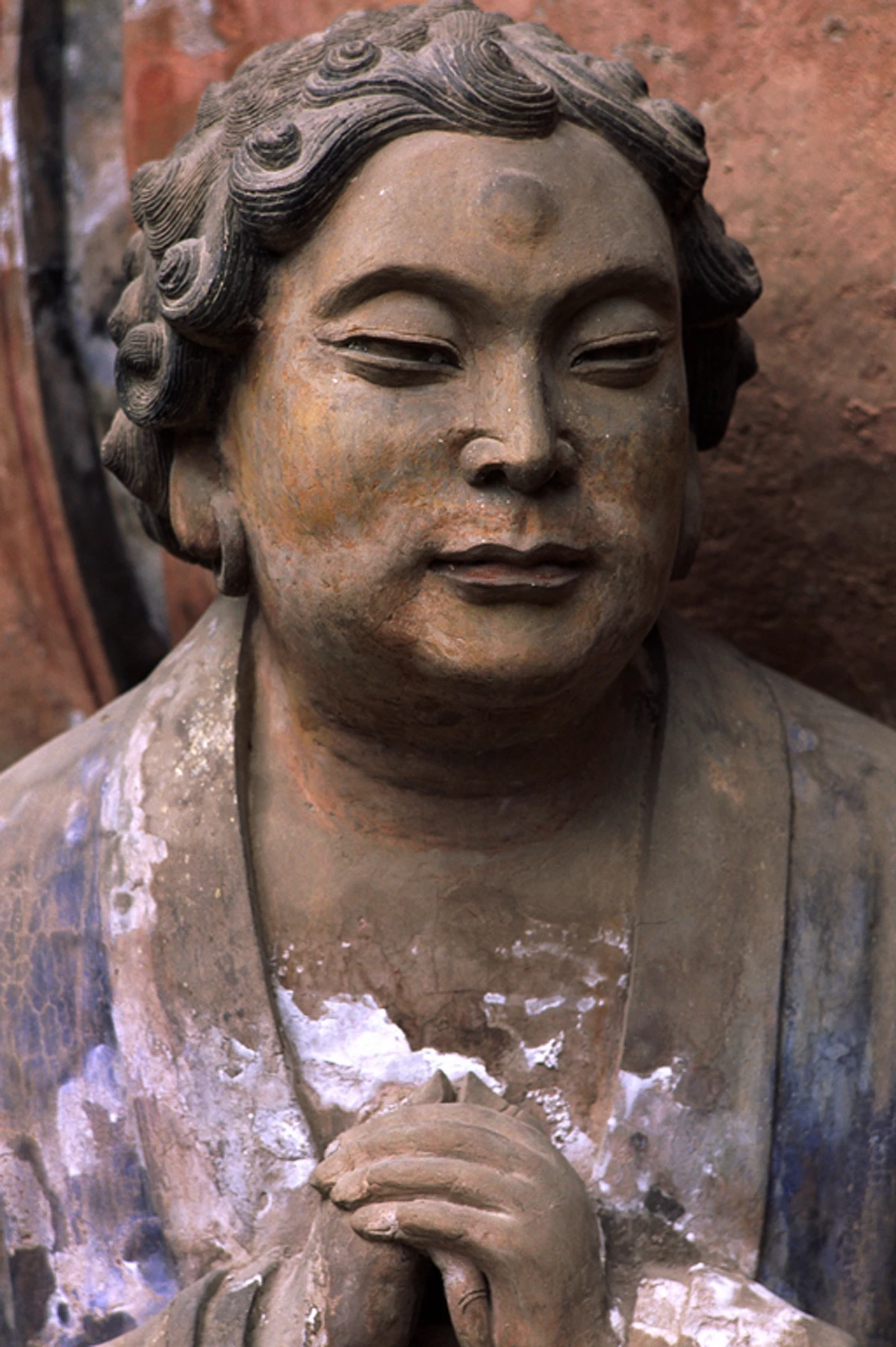
The earliest Beishan carvings are among the most beautiful things in all of Chinese art. The bodhisattva figures from the late Tang and Five Dynasties period (9th–10th century) are characterized by their elegant proportions, flowing robes, and serene expressions. They represent a Tang aesthetic of plump, graceful beauty that is unmistakable—full cheeks, elongated eyes, robes that seem to ripple in invisible wind.
By the Song dynasty (10th–13th century), the style had shifted. The figures became more individualized, more grounded in everyday reality. Song-era Beishan carvings include not only Buddhist deities but also scenes of ordinary life—musicians, dancers, fishermen—that reflect a growing interest in the human world alongside the divine.
The Taoist Exception: Nanshan and Shimen
While the three-faith synthesis is Dazu’s defining characteristic, two sites—Nanshan (南山) and Shimen (石篆山)—are notable for being predominantly Taoist. This is extremely rare in Chinese grotto art. Taoism, despite being one of China’s indigenous religions, left far fewer stone carvings than Buddhism, making the Taoist panels at Dazu uniquely valuable.
The Nanshan carvings feature depictions of Taoist deities, immortals, and cosmological scenes that are essentially absent from other major grotto sites. The Shimen carvings similarly focus on Taoist iconography alongside Confucian themes, creating what amounts to a stone encyclopedia of Chinese religious thought.
For scholars of Chinese religion, these sections are as important as the Buddhist masterworks at Baoding. For casual visitors, they offer a fascinating counterpoint—a reminder that Dazu’s genius lies not just in its Buddhist art but in its vision of a spiritual world where all three traditions could coexist.
A Thousand Years of Weather: Conservation at Dazu
The Dazu Rock Carvings have endured over a millennium of exposure to Chongqing’s subtropical climate—hot, humid summers, cool damp winters, and constant moisture seeping through the sandstone. The result is a complex conservation challenge that has only grown more urgent with time.
Water is the primary enemy. Rainwater penetration dissolves the binding agents in the sandstone, causing surface erosion and loss of painted detail. Salt crystallization within the stone creates internal pressure that cracks and spalls the carved surfaces. Biological growth—moss, lichen, algae—colonizes the damp surfaces and slowly chemically attacks the stone.
Since UNESCO inscription in 1999, China has invested heavily in conservation infrastructure. Modern techniques include micro-drainage systems to redirect rainwater, humidity-controlled enclosures for the most vulnerable carvings, and laser-based monitoring of surface degradation. The Thousand-Hand Guanyin restoration demonstrated that even severely damaged masterpieces can be brought back from the brink, but the ongoing maintenance of 75 sites across an entire mountain district remains an enormous undertaking.
◆ Visitor Tip: The best time to see the carvings is on overcast days. Direct sunlight washes out the subtle painted details and creates harsh shadows that flatten the three-dimensional forms. Chongqing’s frequent cloud cover is, for once, a blessing.
Practical Information
Getting There
By High-Speed Rail (Recommended)
- Route: Chongqing West Station (重庆西站) → Dazu South Station (大足南站)
- Duration: Approximately 30 minutes on the high-speed line
- Frequency: Multiple daily departures
- Cost:
¥40 ($6)
From Dazu South Station to the Sites
- Bus 205 runs from Dazu South Station to Baoding Mountain
- Duration: Approximately 40 minutes
- Cost:
¥5 ($0.70) - Alternative: Taxi from station to Baoding Mountain costs
¥80–100 ($11–14)
Opening Hours
| Season | Hours |
|---|---|
| March–October | 8:30–18:00 |
| November–February | 9:00–17:00 |
Tickets
| Ticket Type | Price |
|---|---|
| Baoding Mountain + Beishan Combo | ¥140 (~$20) |
| Baoding Mountain Only | ¥115 (~$16) |
| Beishan Only | ¥50 (~$7) |
| Students (with ID) | 50% off |
Suggested Itinerary
| Time | Activity |
|---|---|
| 08:30–09:00 | Arrive at Baoding Mountain (beat the crowds) |
| 09:00–12:00 | Explore Baoding Mountain (2–3 hours): Thousand-Hand Guanyin → Hell Scenes → Reclining Buddha → Wheel of Reincarnation → Sutra Mountain |
| 12:00–13:00 | Lunch at Baoding Mountain entrance area (local Sichuan-Chongqing cuisine) |
| 13:00–13:40 | Bus/taxi to Beishan |
| 13:40–15:30 | Explore Beishan (1.5 hours): Tang bodhisattvas → Song narrative panels → Wheel of Life |
| 15:30–16:30 | Return to Dazu South Station → High-speed rail back to Chongqing |
Best Time to Visit
- Ideal: March–June or September–November (mild weather, fewer crowds)
- Avoid: July–August (Chongqing’s brutal summer heat, temperatures regularly exceed 40°C/104°F)
- Note: Weekends and Chinese national holidays bring significant crowds. Weekday visits are strongly recommended.
Tips for Visitors
- Baoding Mountain is the must-see. If you have limited time, spend all your hours there. Beishan is wonderful but secondary.
- Hire a guide. The carvings are packed with narrative detail that is invisible without explanation. Licensed guides are available at the entrance for
¥150–200 ($21–28) per group. - Bring water and comfortable shoes. The sites involve significant uphill walking on stone paths.
- Photography is allowed but flash is prohibited in most indoor areas.
- Combine with Chongqing city. Dazu makes an easy day trip from Chongqing, but if you want to explore more of the district’s 75 carving sites, consider an overnight stay.
Budget Estimate (Per Person, One Day)
| Item | Cost (CNY) | Cost (USD) |
|---|---|---|
| High-speed rail (round trip) | ¥80 | ~$11 |
| Combo ticket | ¥140 | ~$20 |
| Local bus (round trip) | ¥10 | ~$1.40 |
| Lunch | ¥40–60 | ~$6–8 |
| Guide (optional, shared) | ¥40–50 | ~$6–7 |
| Total | ¥310–340 | ~$44–48 |
Frequently Asked Questions
Q: How does Dazu compare to Longmen or Dunhuang? A: Longmen and Dunhuang are older and more purely Buddhist. Dazu’s uniqueness lies in its three-faith synthesis and its narrative, pedagogical design. If you’ve seen Longmen’s massive Vairocana Buddha, Dazu offers a very different experience—smaller individual figures but vastly more complex storytelling.
Q: Can I see everything in one day? A: Yes, but barely. Baoding Mountain alone deserves 2–3 hours, and Beishan needs at least 1.5 hours. A full day (8:30 departure from Chongqing, return by 18:00) is tight but doable if you prioritize Baoding.
Q: Is there an audio guide?
A: Yes, multilingual audio guides (including English) are available at the Baoding Mountain entrance for ¥40 ($6). Alternatively, the official Dazu Rock Carvings app offers self-guided audio tours.
Q: Is the site wheelchair accessible? A: Partially. Baoding Mountain has some paved paths but also significant inclines and stone steps. Beishan is generally easier to navigate. Wheelchair users should check current accessibility information before visiting.
Q: Are there English signs? A: Basic directional signs are in English. Detailed informational plaques are primarily in Chinese with limited English summaries. This is why a guide or audio tour is highly recommended for English-speaking visitors.
Q: Can I visit the lesser-known 75 sites beyond Baoding and Beishan? A: Most of the other 73 protected sites are small, scattered across the district, and require local knowledge to find. Some, like Nanshan and Shimen, are open to visitors but have limited infrastructure. For a first visit, Baoding and Beishan cover the essential experience.
The Dazu Rock Carvings remind us that stone, given enough time and devotion, can become a library. Every figure, every gesture, every moral lesson carved into these cliffs speaks across centuries—a conversation between medieval faith and modern wonder that shows no sign of falling silent.